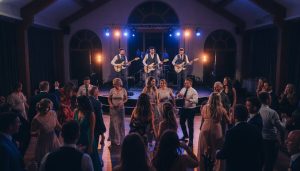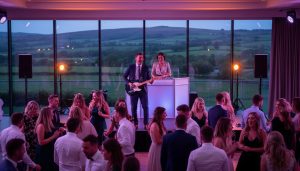
A packed dance floor does not always require a huge rock-band set-up. What is amplified acoustic music? It is the sweet spot between the warmth of live, organic instruments and the punch needed to carry a room full of wedding guests. Think guitars, percussion, keys and harmony vocals played live, then professionally amplified so every lyric, rhythm and musical lift lands exactly as it should.
For couples who want the personality and closeness of an acoustic performance without sacrificing a proper party later on, it can be a brilliant answer. It feels polished rather than over-produced, lively without being shouty, and familiar without falling into the same old wedding-band formula.
What is amplified acoustic music, exactly?
Amplified acoustic music is performed on instruments that retain an acoustic character – such as acoustic guitars, cajon or compact percussion, piano or keyboards, and hand-played rhythm instruments – but are connected to a professional sound system. Vocals are mic’d, instruments are balanced, and the overall sound is shaped for the size and character of the room.
The point is not simply to make an acoustic guitar louder. Good amplification gives the music clarity, detail and dynamic range. A soft first-dance vocal can still feel intimate. A huge chorus can then open up, with tight percussion, layered harmonies and a bass-rich pulse that gets people out of their seats.
That distinction matters at a wedding. Unamplified music can be beautiful for a small ceremony or a quiet corner of a drinks reception, but it can disappear quickly once guests are chatting, glasses are clinking and a room begins to fill. Amplified acoustic music keeps the natural tone while giving the performance enough presence to hold the atmosphere.
Why it works so well for weddings
A wedding asks a lot of its music. During the ceremony, it needs to support a once-in-a-lifetime moment without overwhelming it. At the drinks reception, it should create a sense of occasion while allowing guests to catch up. Later, it needs to shift gears and deliver the songs everyone knows, loves and will happily sing at full volume.
An amplified acoustic line-up can move through these moments with real ease. The same musicians can bring restraint to an aisle song, play stylishly through the afternoon, then build a full, dance-floor-ready sound for the evening. There is continuity to the day, but no sense of hearing the same set three times.
There is also a visual appeal. Acoustic instruments look at home in a country house, city venue, marquee, hotel ballroom or festival-style celebration. They bring a relaxed, human quality to the room. Yet with the right arrangements and sound production, they do not have to feel low-key.
For many couples, that balance is the attraction. They want their favourite songs to have energy, but they also want the performance to feel like their wedding rather than a generic nightclub set.
The sound: intimate, but never small
The word “acoustic” can sometimes suggest gentle background music. It can be that, when the moment calls for it. But amplified acoustic music can also be seriously high-energy.
The difference lies in arrangement. A talented band does more than play a chart hit on an acoustic guitar. They rework it for their instruments, build rhythmic hooks, use vocal harmonies intelligently and create rises and drops that make a chorus feel enormous. A well-placed mash-up can turn two familiar songs into one brilliant dance-floor moment. A stripped-back opening can make the final chorus hit even harder.
Percussion is often a key ingredient. Rather than relying on a full drum kit throughout, players might use cajon, stomp pedals, shakers, tambourine and electronic elements where appropriate. This creates movement and impact while keeping the sound agile and less heavy than a conventional rock set-up.
The result is a performance with plenty of pulse, but more space around it. Guests can hear the character of the voices, the strum of the guitar and the cleverness of the arrangement. It feels live because it is live.
What instruments and production are involved?
Every act has its own approach, so amplified acoustic music is not one fixed format. A trio may combine acoustic guitar, keyboards, percussion and multi-instrumental touches, with all members contributing vocals. Another group may include upright bass, fiddle or brass. The defining feature is the acoustic-led musical identity, supported by amplification rather than replaced by it.
Professional sound equipment is part of the experience. Speakers, microphones, mixing and careful volume control allow the band to tailor the performance to the venue. A ceremony in a bright, echoing room requires a different treatment from an evening party in a marquee, and both require more thought than simply turning everything up.
This is where experienced wedding musicians earn their keep. They know when the music should sit gently under conversation, when it should command attention, and how to create a full sound without making the room uncomfortably loud. Great volume is not about sheer decibels. It is about impact, balance and the confidence that nobody will miss the big moments.
Where amplified acoustic music fits across the day
It is particularly useful for couples booking entertainment for more than one part of the celebration. At the ceremony, amplified acoustic musicians can perform processional songs, the signing of the register and the recessional with enough clarity for every guest to share the moment. The right performance turns a much-loved song into something distinctly personal.
For drinks receptions, the tone can be relaxed but upbeat. Guests are arriving from the ceremony, greeting family members and taking photographs. A repertoire of soulful classics, modern favourites and inventive arrangements adds atmosphere without making conversation a competitive sport.
Then comes the evening. This is where some people assume acoustic instrumentation cannot match a standard party band. In reality, a strong amplified acoustic act can bring enormous energy to pop, indie, disco, soul and singalong anthems. The sound may be different from a five-piece band with a full drum kit, but different is not lesser. It is often more distinctive, especially when the vocal blend and song choices are first-rate.
A DJ set after the live performance can also make perfect sense. Live music gives the party its personality and shared moments; a DJ can keep the momentum going into the later hours with the tracks your guests cannot resist.
Is it right for your guest list and venue?
It depends on the kind of atmosphere you want. If your dream is a wall of electric guitars and a full-scale rock concert, a conventional larger band may be the better fit. If you are planning a very large event with hundreds of guests, you may also prefer a line-up with a bigger visual footprint.
But if you want musical sophistication, warmth and proper party energy in one package, amplified acoustic music deserves serious consideration. It is especially effective for mixed-age guest lists because the arrangements can feel fresh to younger guests while the songs remain instantly recognisable to parents, aunties, uncles and everyone in between.
Venue restrictions can be a factor too. Some Irish wedding venues have sound limiters or need bands to work carefully within particular noise levels. An acoustic-led set-up is not a loophole around those rules, nor should it be treated as one. However, a skilled act can often produce a vibrant, satisfying sound at a more manageable volume than a louder full-band format.
When speaking with a band, ask how they handle ceremony sound, drinks reception volume, evening dance-floor sets and DJ music. Ask whether they provide their own professional PA and lighting, and whether the line-up can be shaped around your schedule. Those practical details make a noticeable difference on the day.
The real value is in the performance
Two bands can have similar instruments on stage and sound completely different. The magic is in musicianship: the quality of the singers, the groove of the rhythm, the confidence between songs and the ability to read a room. A brilliant arrangement is only brilliant if it makes people feel something.
That is why an experienced act such as The Hitmen Trio puts as much care into the flow of a set as the song list itself. The goal is never to play music at a wedding. It is to create moments: the gasp when a ceremony song begins, the first group singalong of the night, the unexpected mash-up that sends guests rushing back to the floor.
Choose the music that sounds like you, then choose musicians who know how to make it fill the room. Your guests may not discuss the technicalities of amplification afterwards, but they will remember how the day felt.