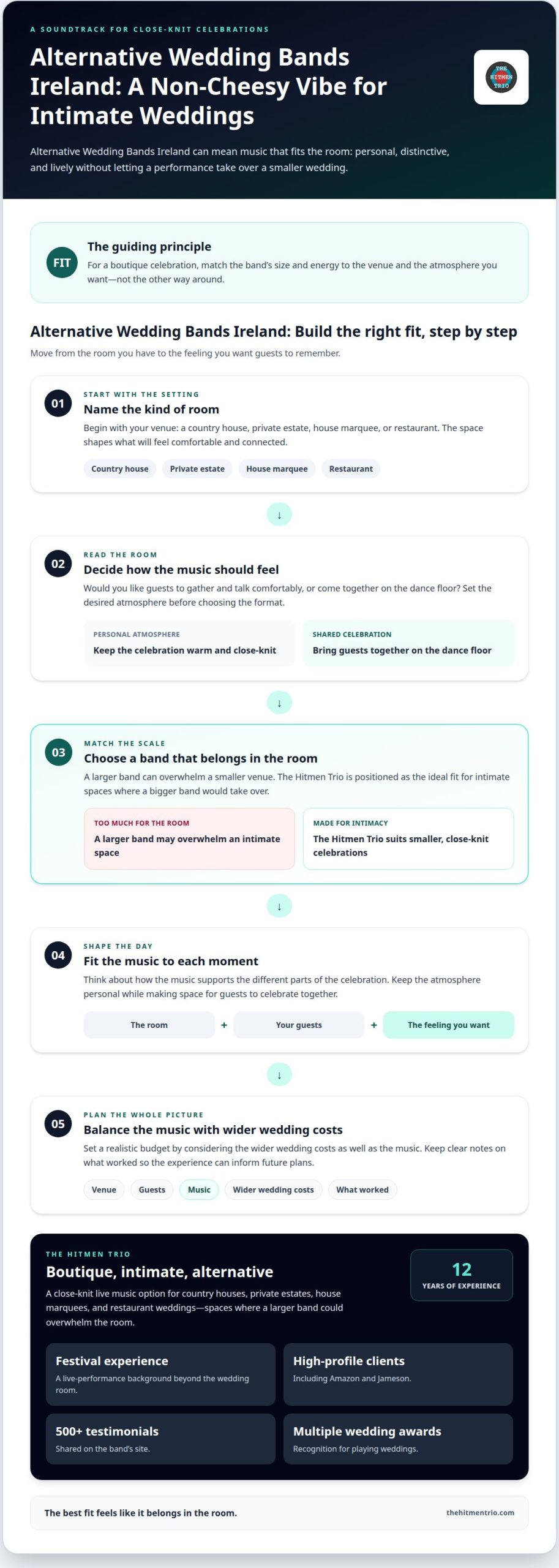
For couples considering alternative wedding bands, a smaller wedding deserves music that fits the room, rather than a performance that takes it over. In a country house, private estate, marquee or restaurant, an intimate, alternative sound can keep the atmosphere personal while bringing guests together on the dance floor.
Choosing music for a boutique wedding means balancing the venue, your guests and the feeling you want to create. This guide will help you shape the soundtrack for a close-knit celebration and choose an approach that feels distinctive rather than predictable. The right musical style can support each part of the day without overwhelming the space or losing the warmth that makes a smaller wedding special. The aim is a celebration that feels like yours, with music that belongs in the room.
Key Takeaways for Intimate Alternative Weddings
- Choose music that gives guests a memorable moment without overwhelming a smaller room.
- Build your brief around your venue, from a country house or private estate to a house marquee or restaurant.
- Match the band’s size and energy to how you want guests to gather and celebrate.
- Set a realistic budget by accounting for the wider wedding costs as well as the music.
- Keep clear notes on what worked to help with future wedding plans.
Can entertainment reflect the identity of the company hosting it?
Yes. Live entertainment can make a company’s values tangible when the format supports the event’s purpose. A relaxed acoustic set can suit a relationship-focused gathering, while a lively band can turn a year-end party into a shared celebration. To justify the spend, connect the performance to a clear outcome, such as encouraging conversation, thanking employees or welcoming guests memorably. Then explain how the music’s style and timing support that outcome.
For an event in Ireland, account for the venue’s licence, noise conditions and event terms. Confirm permitted performance times and sound limits with the venue, then plan the set and sound check around them.
Tax treatment matters, too. In Ireland, seasonal parties, special occasion meals and other inclusive employee events are not taxable benefits in kind when expenses are reasonable and the event is available to all employees. If an expense is a taxable benefit in kind, it is chargeable to employees under PAYE for Income Tax, PRSI and USC. Keep the event’s employee audience and purpose clear in the budget records.
Next, map the entertainment to the running order. A performance has more impact when it fits the room and the moment instead of competing with speeches, dinner or conversation. For example, schedule a quieter set during a drinks reception, then move to higher-energy music after formal remarks. Share the event sequence with the performers so transitions, announcements and sound checks fit the evening.
Audience fit matters as much as company identity. Consider the team’s mix of roles, social groups and guests, then choose a format that lets people join in comfortably. At a seated dinner, music that supports conversation may work better early in the evening. A dance-focused set can become the centrepiece once guests move into a more social part of the party.
A memorable moment need not mean a long performance. A well-placed ten-minute surprise can carry more weight than an extended stage set. It could be a short musical entrance before an awards presentation or a lively change of pace after dinner. Make the moment relevant to the event, not an interruption that leaves guests wondering why it is there.
Use this simple sequence to connect spending with purpose:
- Name the outcome: choose a result, such as stronger team connection or a celebratory finale.
- Match the format: consider the audience, venue, event tone and running order.
- Explain the value: show how the performance creates the intended experience.
- Capture feedback: ask employees specifically about the entertainment after the event.
A clear case for justifying a live entertainment budget for a company party
Show that the music has a defined role, suits the guests and contributes to the experience the company wants them to remember.
What should a corporate Christmas party entertainment brief include?
A useful Christmas party brief turns a broad idea into decisions the finance and events teams can assess. Start with the event’s purpose: celebrating the year, thanking employees or helping colleagues connect. Add the team’s history, social mix and existing dynamic. A close-knit team may enjoy a participatory evening; a mixed group may prefer entertainment that welcomes people without putting anyone on the spot.
Set out the whole budget, not just the performance allocation. Include venue, food, sound or production requirements, transport and other event costs where they apply. Then explain why the proposed entertainment suits the audience and intended atmosphere. Proportionality means showing a clear connection between the expense, the event’s purpose and the people attending, rather than viewing one line item in isolation.
Include practical details that make a quote and booking easier to process: the event date, venue, expected attendees, schedule, business purpose and decision-maker. Add the performance format you have in mind, relevant timings and any venue constraints. A band scheduled after dinner, for example, needs a different running-order slot from background music during a reception.
Corporate bookings also involve paperwork. State whether your organisation needs a purchase order before confirming, which entity should appear on the invoice and what reference finance requires. Request itemised invoice details that match the booking, then retain them with the event record. If an employee or director pays personally and the company reimburses the cost, the tax treatment is the same as if the company paid directly.
For Irish Corporation Tax, give your finance team the event purpose, attendee details and itemised entertainment records so they can assess the expense correctly. Don’t assume that calling a gathering a staff party determines its tax treatment. The business context and supporting documentation matter.
Give cancellation and insurance a clear place in the brief. Record the agreed cancellation terms, payment milestones, responsibilities if plans change, and the insurance arrangements that apply to the event and performance. This gives the organiser a practical reference if a venue change or disruption affects the schedule.
Before sending the brief, check that it answers these points:
- Purpose: what employees should experience or remember.
- People: who is attending and what the team dynamic is like.
- Plan: date, venue, running order and performance requirements.
- Finance: total event costs, purchase order process and invoice details.
- Records: business purpose, attendee information and itemised receipts.
A concise, specific brief gives corporate event music planning a clear starting point and helps keep the entertainment aligned with the party’s purpose.
Matching entertainment to the audience and team dynamic
A company audience is rarely one uniform crowd. Before choosing a performance style, consider colleagues’ interests, how they socialise and whether guests from outside the organisation will attend. A team that enjoys dancing may welcome a high-energy set, while a mixed employee-and-client gathering may need a gentler opening that leaves room for conversation.
Consider the event format, too. At a seated Christmas dinner, a performance during the meal can make speeches harder to hear and conversation difficult. A set after dinner gives the evening a clearer shift from formal proceedings to celebration. For a reception where guests arrive at different times, music that works without demanding everyone’s attention can suit the flow.
The team’s existing dynamic can guide how interactive the entertainment should be. A close-knit group that enjoys joining in may respond well to a singalong moment. If colleagues rarely socialise across departments, a performance requiring volunteers could feel awkward. Choose an approach that invites participation without putting anyone on the spot.
Room layout shapes the audience experience. A close-up performance moving table by table can create intimacy and conversation, unlike a stage performance. In a compact venue with tables, that format may help guests feel involved. In a larger room, a focal performance can give the gathering a shared centre of attention.
Think about the evening’s energy, not just the headline set. If the first part is a meal and awards, start with music that supports conversation. Then shift to more upbeat music after the formal programme. This gradual change gives guests different ways to take part, from listening at their table to joining the dance floor.
A short preference exercise can help the organiser understand the group without letting a popularity contest dictate the booking. Use a Google Form with three prompts: favourite party atmosphere, preferred level of audience participation and music styles to avoid. Treat responses as clues about the room, not a promise to satisfy every individual taste.
Use the answers to make a practical match:
- Mixed ages or guests: choose a format with a welcoming opening and room for conversation.
- Reserved team: prioritise entertainment that doesn’t rely on audience participation.
- Close-knit, lively group: consider a more energetic set later in the evening.
- Table-based venue: weigh close-up performance against a central stage format.
This audience-led approach connects the entertainment choice to the experience employees and guests will actually have, rather than assumptions about what a company party should sound like.
Reflecting company identity through entertainment
Entertainment can express a company’s character without turning a party into a presentation. Start by choosing three qualities the event should communicate, such as inventive, welcoming or energetic. Then translate each quality into a practical choice. An inventive technology firm might favour fresh arrangements over familiar party standards; a relationship-led organisation might choose music that supports conversation before the dance floor opens.
Use the company’s everyday culture as evidence, not just its brand colours or slogan. Ask what employees recognise in a typical working day. A collaborative team may value shared participation, while a company that prizes craft might appreciate musicianship and thoughtful arrangements. These examples help explain why a performance fits the organisation instead of seeming like a decorative extra.
Keep the event’s purpose in view. A celebration after a demanding year calls for a different atmosphere from a formal awards evening. A lively finish can signal a genuine release from work, while a polished, measured set can complement presentations without competing with them. Note the intended mood in the event plan so the entertainment supports the message from arrival to finale.
Company identity has a sound, too. Consider whether the organisation feels contemporary, traditional, playful or understated, then use that impression to guide the musical style. A design studio might choose an unexpected acoustic arrangement of a recognisable song. A heritage business could favour familiar favourites with a fresh edge. The goal is recognition, not a literal soundtrack to the company’s marketing.
Personal touches can make the connection more specific. A song associated with a milestone, a short musical cue before an awards announcement or a bespoke transition between dinner and dancing can add a human detail. Choose moments that make sense to employees; an inside reference understood by only a small leadership group may leave the wider audience out.
To build a clear case for the spend, record the link between identity and experience:
- Choose the message: name the qualities guests should feel, such as warmth or boldness.
- Translate it into choices: match musical style, performance format and timing to those qualities.
- Explain the guest benefit: describe how each choice supports connection, celebration or recognition.
- Review the result: ask employees whether the atmosphere felt true to the organisation.
This approach gives budget discussions a concrete rationale. Instead of saying the entertainment “felt right”, explain how its style, placement and personal details expressed the company’s character for the people in the room.
Setting a realistic entertainment budget
Start with the event’s purpose, then decide what the entertainment must contribute. A company party designed for dancing needs a different format from a reception focused on conversation. List the performance, sound requirements, venue costs, food, transport and contingency needs together. This gives finance a fuller picture than a performer fee alone.
How much do Irish bands, DJs, comedians and other corporate entertainers charge? There is no dependable rate for every act or event; costs depend on the brief and its requirements. Define the format, schedule and venue needs, then request a quote for that specific event.
For lower-cost alternatives to a live band, consider a carefully curated playlist, a DJ, or a shorter live set paired with recorded music. The right choice depends on whether the event needs a shared focal point, continuous music or simply a soundtrack for conversation.
Several factors shape corporate entertainment quotes in Ireland: the type of act, performance duration, event date, travel, venue access and technical requirements. A performance requiring additional sound equipment or a complex schedule may involve different costs from a straightforward set. Give each provider the same event details so you can compare like with like.
Build the estimate around the whole experience. A company planning dinner followed by dancing, for example, should consider whether the venue’s sound system suits both parts. A reception with speeches may need clear pauses and transitions. Confirm how setup, sound checks and breaks fit the running order, since these details affect the event plan as well as the entertainment allocation.
Keep proportionality visible. Explain why the format matches the guest list and intended outcome, then compare it with other planned expenses. A high-profile performance may be hard to justify if guests will spend the evening talking over it. A smaller, well-timed set may be a better fit when it creates the atmosphere the party needs.
To make the figures useful for future planning, record the agreed scope and final event costs. After the party, gather feedback specifically about the entertainment. If employees valued the music and its timing, that response can support a similar format next year. If it interrupted conversation or left the dance floor empty, adjust the brief instead of automatically repeating the same allocation.
Use these steps to structure the budget:
- Define the outcome: decide whether the priority is conversation, dancing or a celebratory moment.
- List full event costs: include venue, production and other planned expenses.
- Compare equivalent proposals: share the same date, schedule and requirements with entertainment vendors.
- Review the result: use post-event feedback to inform the next budget discussion.
That gives the finance team a clear basis for assessing the spend: purpose, scope, alternatives and the experience delivered.
The Hitmen Trio: An Alternative for Intimate Weddings
The Hitmen Trio is a premier choice for smaller, intimate weddings, where a larger band could overwhelm the room. In country houses, private estates, house marquees and restaurant settings, the trio’s acoustic sound can bring energy while keeping the atmosphere close and personal. With 12 years of experience, festival performances and appearances for high-profile clients including Amazon and Jameson, the band brings seasoned live-event experience. It has over 500 testimonials on its site and has won multiple awards for playing weddings.
That experience makes live music a considered option for boutique weddings. Share your venue and plans to help shape a performance that fits your intimate celebration.
Contact The Hitmen Trio to discuss music for your intimate wedding.
Take the next step with confidence
Turn your entertainment budget into a decision finance can assess. Name the experience you want to create, identify who needs to approve it and involve them before the programme is finalised. That keeps the choice connected to the event instead of making it a last-minute add-on.
Justifying live entertainment budget for a company party becomes more straightforward when everyone understands music’s role. Keep the discussion focused on the atmosphere you want and the value it brings to the occasion. Stakeholders may favour different styles, but a shared purpose gives them a practical basis for choosing.
When you’re ready to shape the next step, talk through your company party plans with The Hitmen Trio. A considered choice can help set the tone for an evening your team will enjoy.
Frequently Asked Questions
What is the difference between entertainment that works and entertainment that is just there?
Entertainment works when it has a clear role in the event, rather than simply filling silence. A short musical cue can lift an awards presentation, while an upbeat set can mark the move from dinner to dancing. Consider whether guests can hear speeches, enjoy conversation and follow the transition. When a performance supports the occasion’s flow, it feels intentional; when it competes with everything else, it feels incidental.
What is the average cost of live entertainment for a company party in Ireland?
For a company party in Ireland, costs depend on the act and the event’s requirements. A solo musician, DJ, comedian and band involve different formats, while duration, date, travel, venue access and technical needs can also shape a quote. Build your estimate around the specific event rather than relying on one average. Compare proposals only when they cover similar timings, setup needs and performance arrangements.
How can companies calculate the return on investment of live entertainment at a staff party?
Assess return by comparing the event’s purpose with evidence gathered afterwards, rather than assuming entertainment creates a financial return. Choose a few indicators before the party, such as employee feedback, participation in planned activities or comments about the atmosphere. Ask focused questions after the event and review the responses alongside the total spend. This gives decision-makers useful evidence about whether the entertainment supported the intended staff experience.
What are the benefits of live entertainment for employee engagement and morale?
Live entertainment can give colleagues a shared experience outside their usual work routines. A well-timed performance may create a natural conversation point, give employees a chance to celebrate together and make the event feel distinct from an ordinary work gathering. The format matters: a quiet reception set supports conversation, while a dance-focused performance invites more energetic participation. Neither guarantees improved morale, so use employee feedback to understand the event’s effect.
How do you set a realistic entertainment budget for a company party?
Set a realistic budget by defining the event’s purpose, deciding what role entertainment should play and accounting for other planned costs. Request quotes based on the same event details, including date, venue, timings and technical requirements. Weigh each proposal against its scope, not just its headline fee. Record the final spend and gather targeted feedback afterwards, so the next budget decision reflects what employees actually valued.