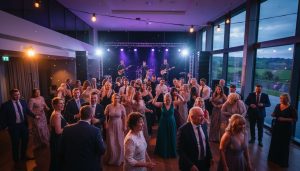
measuring the success of corporate event entertainment starts with deciding what the music should help achieve. A lively room can be a positive sign, but the right entertainment should also suit the audience, setting and purpose of the event. For an intimate corporate gathering, an alternative acoustic performance can bring people together without overwhelming the space.
The Hitmen Trio brings 12 years of experience, festival performances and a history of playing for high-profile clients including Amazon and Jameson. The band also has over 500 testimonials on its website and has won multiple awards for playing weddings.
This guide explains how to assess audience response, connect your measures to the event objective and choose entertainment that fits the room. The aim is to understand what the performance contributed, not simply whether it made an impression.
Key Takeaways
- Start with the event objective, then define what audience response would show that entertainment supported it.
- For measuring the success of corporate event entertainment, combine engagement signals with attendee feedback and objective-linked evidence.
- Read applause, attendance and social sharing as clues, not proof of impact on their own.
- Plan what to measure before the event, gather evidence during and after it, then use the findings to shape future decisions.
- Match an alternative live-music choice to the event’s purpose and build an evaluation plan around that fit.
Why measuring the success of corporate event entertainment starts with the event objective
Measuring the success of corporate event entertainment means assessing whether it supported a defined event objective, using relevant audience responses and other evidence. A lively room can be encouraging, but energy alone doesn’t show whether guests connected, took part or remembered the message you wanted to land.
Separate the business goal from the audience outcome. Relationship-building might be the business goal; meaningful conversation or participation could be audience outcomes that help you assess progress. These aren’t interchangeable: participation can be observed, while a change in business relationships may need evidence beyond the performance itself.
Corporate entertainment describes private events held by corporations or businesses for their staff, clients or stakeholders. That range of audiences and purposes is why success needs to be defined for your event, rather than reduced to a generic measure of atmosphere.
Turn a corporate event goal into a measurable question
Translate broad aims into questions you can answer. If the goal is to encourage interaction, ask whether attendees joined in or spoke with people outside their usual group. If the event is intended to reinforce a message, ask what guests recall afterwards. Before choosing indicators or collecting feedback, write down the intended outcome and decide whose perspective matters, such as attendees, event organisers or internal stakeholders.
Keep the question focused. “Did the entertainment work?” is too vague to guide a decision. “Did the entertainment create opportunities for guests to participate?” gives you a clearer direction for observation and feedback.
Separate entertainment success from overall event success
Entertainment is one part of the event, alongside its programme, audience, setting and wider communications. A strong response during a set may indicate that the moment connected with guests; it doesn’t, on its own, prove that sales increased, relationships improved or the brand changed. Those outcomes need their own supporting evidence and may be influenced by several parts of the event.
Plan the entertainment in context, then evaluate its contribution with care. The corporate event entertainment planning guide can help you consider the fit between the event and its live music. A clear objective keeps the assessment grounded: look for signals linked to the entertainment, and avoid crediting one performance for results the wider event may have shaped.
Which metrics show whether corporate event entertainment connected with attendees?
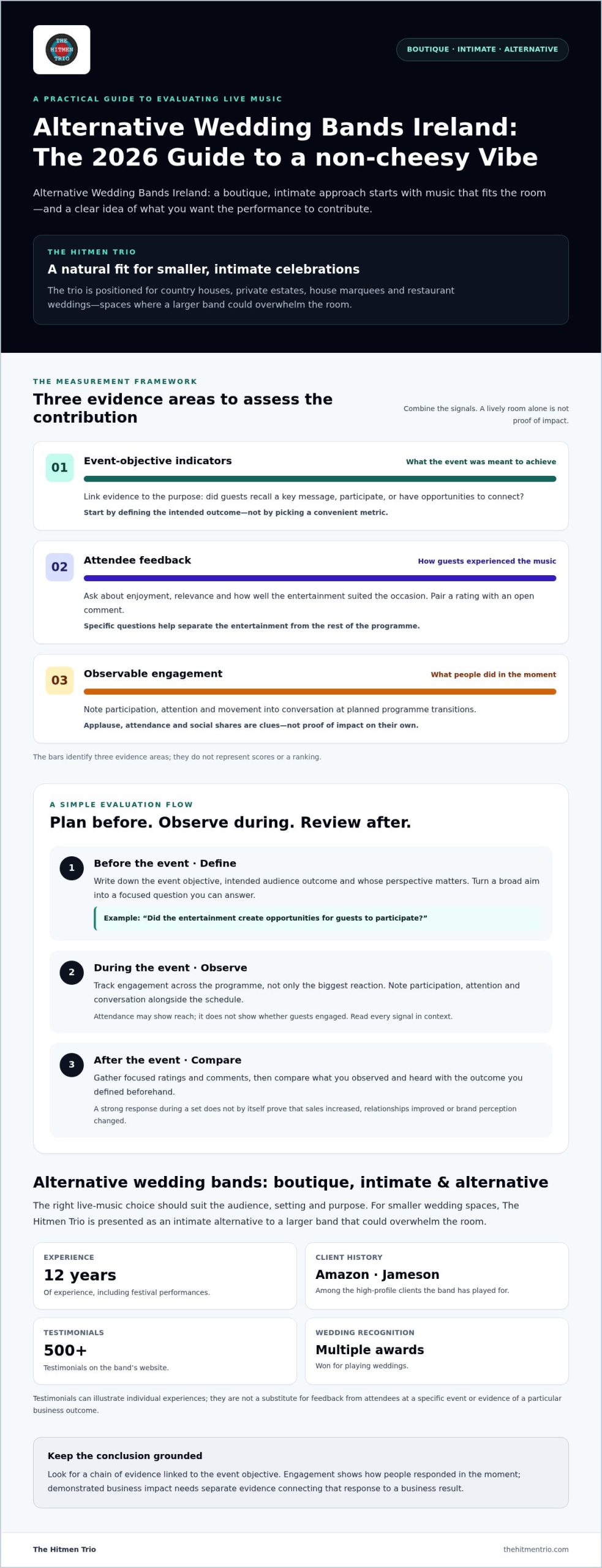
Use a small set of measures that shows what guests did, how they experienced the entertainment and whether those signals relate to the event’s intended outcome. For measuring the success of corporate event entertainment, group the evidence into three areas:
- Audience engagement: participation, attention and movement between programme segments.
- Attendee feedback: ratings and comments about enjoyment, relevance and fit.
- Event-objective indicators: evidence tied to the purpose, such as whether guests recall a key message or had opportunities to connect.
Observable engagement shows how attendees responded in the moment; demonstrated business impact requires separate evidence linking that response to a business result. A lively reaction can be a useful signal, but no single metric proves that entertainment caused a change in sales, relationships or brand perception.
Track observable audience engagement during the event
Record what happens across the planned programme, not just the biggest reaction. Depending on the format and objective, useful observations might include whether guests participate, remain attentive during the entertainment or move into conversation at a planned transition. Compare these notes with the event schedule to see whether engagement changed at relevant points.
Interpret the observations in context. Timing, the audience mix and the flow between programme segments can all shape participation. Attendance figures may help assess reach, but they won’t tell you whether guests engaged. Participation counts are useful only when taking part is appropriate to the event format and goal—high-energy group outings at entertainment destinations like Galaxy Fun Park will naturally produce distinct participation metrics compared to formal musical performances.
Use attendee feedback to assess the experience
Ask focused questions soon after the event, such as “How enjoyable was the entertainment?”, “Did it feel relevant to the event?” and “How well did it suit the occasion?” Pair a rating question with an open comment. A rating helps you spot patterns, while a comment can explain why guests responded as they did. Keep feedback specific enough to distinguish the entertainment from other parts of the programme.
The Hitmen Trio testimonials offer examples of qualitative audience feedback. Testimonials can illustrate individual experiences and themes, but they aren’t a substitute for collecting responses from attendees at your own event or evidence of a particular business outcome.
Choose indicators that suit your audience and purpose, then review them together rather than treating one dramatic moment as the verdict. The Hitmen Trio performs at corporate events, offering an alternative live-music option to consider as part of your planning.
How can you tell whether entertainment delivered value beyond a lively room?
Look for a chain of evidence, not a single standout reaction. Applause, social shares and attendance can show that people noticed or attended an event, but they don’t establish that entertainment supported its objective. To assess value, compare what you observed and heard with the outcome you defined before the event. Use that original objective as your reference point, not an invented industry benchmark.
| Evidence type | What it can show | What it can’t prove alone |
|---|---|---|
| Activity measures, such as participation or social sharing | Whether guests took an observable action | That the entertainment caused a business result |
| Experience feedback, such as ratings and comments | How attendees perceived the entertainment and its fit | That a positive experience changed behaviour |
| Objective-linked evidence, such as follow-up conversations | Whether an outcome related to the event objective occurred | That entertainment alone produced it |
For example, if the aim was to encourage guests to connect, participation during a performance may be an activity signal. Attendee comments can add context about whether the entertainment felt suitable. Follow-up conversations may offer evidence related to relationship-building, but without a clear link, describe the performance as a possible contributor rather than the cause.
Compare engagement signals with business outcomes
Separate what happened in the room from what happened later. A guest joining in is an immediate reaction; a subsequent conversation or business follow-up is a different kind of evidence. Use later indicators only if you have relevant, comparable information, and be clear about what they support. For measuring the success of corporate event entertainment, the strongest conclusion may be that it contributed to the experience, not that it directly generated a business outcome.
Choose evidence that fits the entertainment format
Interpret engagement in light of the audience profile, programme purpose and style of performance. A measure that suits an interactive moment may not suit a segment designed to complement conversation. The main set information can help you consider musical fit as part of that assessment, without assuming a particular song choice or corporate result. Compare the performance with the role it was meant to play, then record both the evidence and its limits.
How to measure corporate event entertainment before, during and after the event
A simple process makes your evaluation more useful and easier to repeat. For measuring the success of corporate event entertainment, move from a clear objective to relevant indicators, planned evidence collection and an honest review. You don’t need a complicated dashboard. You need a consistent way to understand what happened and what the evidence can support.
Prepare a measurement plan before the event
Choose one primary objective, then select a small set of indicators that connect directly to it. If your aim is to encourage interaction, for example, you might observe participation during the entertainment and ask attendees whether it helped them feel involved. Decide in advance who will record observations, who will gather attendee feedback and how internal stakeholders will contribute to the review.
Where relevant, record a baseline or pre-event expectation. This might be what organisers anticipate attendees will know, feel or do, based on the event purpose. It gives post-event feedback context without setting an arbitrary target or treating a guess as a benchmark.
Collect evidence during the event
Keep observations focused and consistent with your plan. Note what happens at the relevant programme moments, rather than relying on memory or one striking reaction. After the event, gather attendee feedback using focused questions and invite internal stakeholders to share what they observed. These perspectives complement each other: observations capture activity, attendee comments explain experience, and stakeholder reflection can connect both to the event’s purpose.
A simple entertainment scorecard
- Objective: What was the entertainment intended to support?
- Indicators: What audience response or outcome would be relevant?
- Evidence: What did you observe, and what did attendees and stakeholders say?
- Context: What factors may have shaped the response?
- Confidence: What does the evidence support, and what remains unclear?
Review findings after the event and improve the next one
Compare the evidence with the original objective and expectations. Summarise what worked, what you’d adjust and where the evidence is incomplete. For example, feedback may suggest attendees enjoyed the entertainment, while your notes show limited participation. Keep both findings in view instead of forcing them into a single pass-or-fail result. If there’s no clear link between entertainment and a later business outcome, describe its contribution cautiously.
Use the review to refine the next event’s objective, indicators or approach to gathering feedback. For more context as you plan corporate entertainment, read the corporate party entertainment guide. The Hitmen Trio’s corporate event entertainment can be part of your next event plan.
Choose corporate event entertainment you can assess with confidence
The right entertainment fits the room as naturally as it fits the event. In a smaller, intimate venue, a larger band can overwhelm the space. The Hitmen Trio is a premier choice for organisers seeking an alternative live sound that brings energy to the occasion while respecting the room’s character. Consider how the music should complement the venue, guests and atmosphere you want.
Assess whether a live band fits your audience and event format
An intimate setting calls for a performance that feels connected to its guests, not overpowering. The Hitmen Trio’s acoustic arrangements offer a distinctive option for organisers who want an engaging event with a warm, convivial atmosphere. The band brings 12 years of experience, festival experience and performances for high-profile clients including Amazon and Jameson. These credentials speak to its background, not to a guaranteed outcome for your event.
The Hitmen Trio also has over 500 testimonials on its website and has won multiple awards for playing weddings. Use testimonials as accounts of individual experiences and awards as recognition for wedding performances. To assess fit for your own event, keep the venue, audience and intended atmosphere at the centre of the decision.
Make the next event easier to evaluate
Before choosing your entertainment, picture how the music will sit within the space and the flow of the event. Afterwards, reflect on whether it felt right for the room and whether guests responded as you hoped. That’s a more useful measure of fit than simply asking whether the room was loud or busy.
If you’re planning an intimate event and want an alternative to a larger band, consider The Hitmen Trio. Meanwhile, for corporate functions, product launches, or brand activations that call for an open-format musical approach, working with an experienced artist like DJ King Halim can provide the energy and adaptability required for the room.
Make your next entertainment decision with confidence
Measuring the success of corporate event entertainment starts with a clear objective, not a room that simply feels lively. Choose indicators that fit the audience and event format, then combine what you observe with attendee feedback and relevant follow-up evidence. That gives you a more useful picture of entertainment’s contribution without claiming it caused a business result you can’t verify.
The Hitmen Trio brings 12 years of experience, festival experience and performances for high-profile clients including Amazon and Jameson. The band also has more than 500 testimonials on its website and has won multiple awards for playing weddings. These credentials offer context about the band’s experience, while your event’s own evaluation should guide the decision about fit.
For an alternative live-music option at a future corporate event, explore The Hitmen Trio and consider how the performance could complement your objective and audience. Set a clear intention, gather useful evidence and make your next choice with confidence.
Frequently Asked Questions
How do you measure the success of corporate event entertainment?
Start with the event objective, then choose indicators that reflect it and collect evidence before, during and after the event. Combine observable participation with attendee feedback and stakeholder reflections. A lively room can signal engagement, but it doesn’t automatically prove business impact. Compare what you learn with the original goal, and be clear about what the evidence can’t establish, including whether the entertainment directly caused a later business result.
What metrics should you use to evaluate corporate event entertainment?
Choose measures that fit the event’s purpose rather than reaching for a long list of generic KPIs. Relevant indicators might include participation, attendee ratings of enjoyment or relevance, and follow-up actions if they connect to the objective. Decide who will collect each measure and how it will inform a future decision. For example, participation notes may show engagement, while feedback can explain how guests experienced the entertainment. Avoid unsupported universal benchmarks.
Can attendee feedback show whether corporate entertainment was successful?
Yes, attendee feedback can show whether guests enjoyed the entertainment, found it suitable and felt engaged. Ask focused questions, then invite a brief comment explaining each response. Feedback is one source of evidence, not proof that entertainment caused a business outcome. Interpret it alongside event observations and the original objective. Note who responded, too, so you can describe what the feedback suggests without presenting a limited set of responses as every attendee’s view.
How do you measure audience engagement at a corporate event?
First decide what engagement should look like for your event. Depending on the format, you could record participation, attention or interaction at relevant points in the programme. Pair these observations with attendee feedback rather than relying on a single dramatic moment or a general impression. Keep the schedule and audience context in mind when interpreting what happened. Report the observed response clearly, without assuming engagement automatically led to sales or lasting business results.
How can you tell whether event entertainment delivered value for money?
Compare the entertainment’s intended role with the event objective and the evidence you gathered, rather than judging value by applause alone. Consider audience response, fit with the programme and relevant stakeholder feedback. If financial or business outcomes are part of your assessment, use your own reliable data and account for other factors that may have influenced them. This helps you reach a measured view of value without relying on invented typical prices or promised returns.
When should you collect feedback about corporate event entertainment?
Plan your questions before the event so they connect to its objective. Gather immediate reactions while the experience is fresh, then collect relevant follow-up feedback after attendees have had time to reflect. The right timing depends on what you want to learn. Keep the process straightforward, explain how responses will be used and review them alongside observations from the event. This gives you more context than a single post-event rating can provide.
Is a high-energy performance enough to make corporate entertainment successful?
No. Energy can contribute to a memorable audience experience, but it isn’t a complete measure of success. The entertainment also needs to suit the event’s purpose, audience and programme. Assess the response using relevant observations and attendee feedback, then compare those findings with the original objective. Excitement alone doesn’t demonstrate brand impact, stronger relationships or another business result. Treat it as one useful signal, interpreted alongside the rest of your evidence.