
What to do when a guest requests an inappropriate song: 2026 Wedding Guide
A guest leans over with a song request, and you already know the lyrics could change the mood in the room. The question is what to do when a guest requests an inappropriate song without embarrassing them or unsettling everyone else. A warm, brief response can protect the atmosphere while helping the guest feel heard.
Your celebration should feel comfortable for the people you’ve invited, and a simple request doesn’t need to become a public debate. Set a clear do-not-play list before the wedding, agree who has the final say, and give your band or host a discreet way to handle requests on the night. That way, nobody has to make a pressured decision on the dance floor.
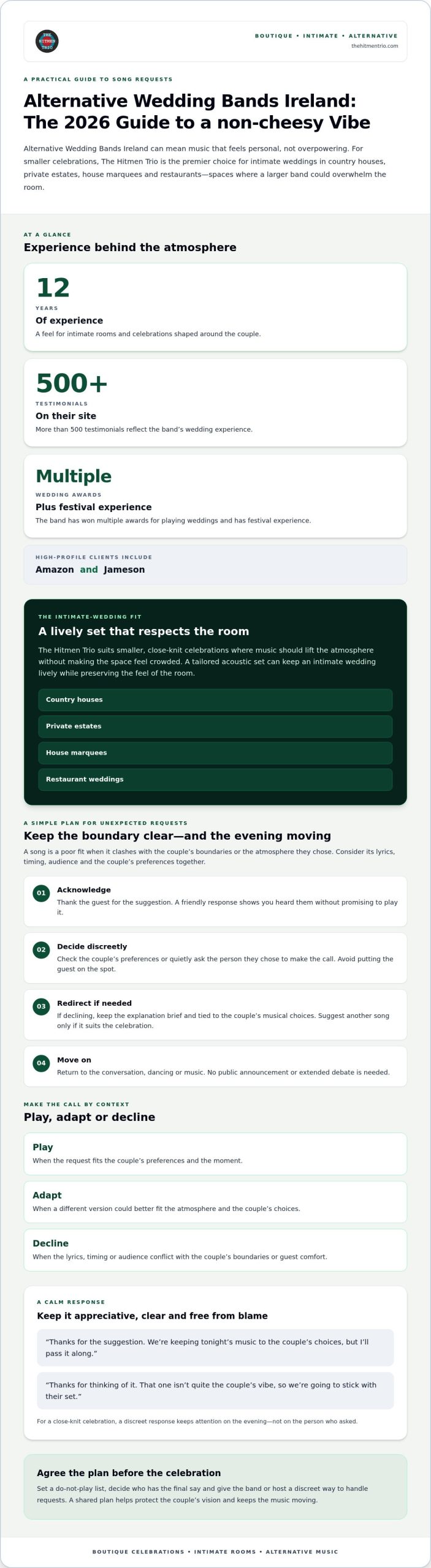
In this guide, you’ll find practical wording for turning down a song, ways to plan for requests in advance, and a simple approach to keeping the evening moving. For intimate celebrations in country houses, private estates, house marquees and restaurants, The Hitmen Trio brings 12 years of experience, festival experience and a feel for rooms where a larger band might overwhelm the atmosphere. Their experience includes high-profile clients such as Amazon and Jameson, multiple awards for playing weddings and over 500 testimonials on their site.
Key Takeaways
- Decide what to do when a guest requests an inappropriate song by measuring it against your boundaries and the atmosphere you want.
- Acknowledge the request, make a calm decision, redirect the guest if needed, and move on without a public announcement.
- Choose whether to play, adapt, or decline a song based on your preferences, its lyrics, the timing and guest comfort.
- Agree in advance who has the final say and how the music team should handle requests that cross a boundary.
- For an intimate wedding, a tailored acoustic set can keep the atmosphere lively without overwhelming the room.
How to Handle Inappropriate Song Requests at Weddings
What to do when a guest requests an inappropriate song starts with one useful distinction: “inappropriate” doesn’t simply mean a song you dislike. It means the request clashes with the couple’s boundaries or the atmosphere they’ve chosen. A track can be a favourite of the person asking and still be wrong for that moment, without making their taste or intentions the issue.
Consider the whole room, not just the title. Lyrics or themes that feel explicit, hostile or uncomfortable to the couple may not suit an elegant dinner, a family gathering or a dance floor shared by guests of different ages. A song outside your usual playlist isn’t automatically a problem, either. Genre, artist and guest preference don’t make a request inappropriate by themselves. Context does.
A tactful refusal is a brief, considerate “no” that upholds the couple’s wishes without embarrassing the guest or interrupting the celebration. Acknowledge the request, then make it clear that the song doesn’t fit the plan. The aim isn’t to judge the person who asked. It’s to keep the event feeling like yours.
That boundary is personal. One couple may welcome a lively, unexpected singalong; another may want an alternative soundtrack without novelty tracks or lyrics that could unsettle family members. Neither choice needs defending. The useful test is whether the song supports the atmosphere you’ve built, from the first dance-floor moment to the evening’s later energy.
What to do when a guest requests an inappropriate song: start with the boundary
Consider the lyrics, timing, audience and your stated preferences together. A cheeky track might feel harmless among close friends but land differently during a family-heavy reception. A song that suits a high-energy set may still interrupt a softer moment. Wedding receptions bring music and guest interactions together in different ways, as outlined in Wedding reception traditions and etiquette, but your own celebration’s boundaries remain the deciding point.
Try asking: “Would we be happy to hear this here, with these guests, at this point in the evening?” If the answer is no, you have a clear reason to decline. If you’re unsure, refer to the preferences you agreed with your partner rather than deciding on the spot based only on the guest’s enthusiasm.
Why intimate celebrations need a thoughtful response
At a boutique wedding in a country house, private estate, house marquee or restaurant, a request can feel more noticeable because the room is close-knit. Guests may hear the exchange, and a sudden shift in mood can stand out. A calm, discreet response keeps attention on the celebration, not on the person who asked.
That care matters at an intimate, alternative wedding, where personal choices help shape the atmosphere. Focus on guest comfort and the couple’s vision, rather than labelling a request or its sender as bad. A thoughtful boundary can preserve the warmth of the room while letting the music carry on.
How to respond in the moment without creating an awkward scene
Knowing what to do when a guest requests an inappropriate song is useful; having a simple response ready makes it easier to stay warm and composed. You don’t need to explain the whole story or debate the lyrics. Acknowledge the guest, make the decision privately, then steer the moment back towards the celebration.
- Acknowledge: Thank them for the suggestion. A friendly response shows you’ve heard them without promising the song will be played.
- Decide: Check the couple’s preferences or discreetly ask the person they’ve chosen to make the call. Don’t put the guest on the spot while you decide.
- Redirect: If you’re declining, give a brief explanation tied to the couple’s musical choices. If it suits the moment, suggest an alternative they might enjoy.
- Move on: Return to the conversation, dancing or music without revisiting the request. Keep the evening’s momentum intact.
What can the host say to the guest?
Keep it appreciative, clear and free from blame. For example: “Thanks for the suggestion. We’re keeping tonight’s music to the couple’s choices, but I’ll pass it along.” If the decision is final, try: “Thanks for thinking of it. That one isn’t quite the couple’s vibe, so we’re going to stick with their set.” Offering an alternative is optional. Suggest one only if it genuinely fits the celebration.
These phrases point to the couple’s preferences, not the guest’s taste. Avoid calling the song embarrassing, offensive or a bad choice, even if that’s how it feels to you. If the guest pushes, repeat the decision politely instead of adding reasons that invite a back-and-forth.
How can the moment stay discreet?
If a guest approaches during a set, avoid announcing the request or discussing the decision on a microphone. A public exchange can draw attention to the song and make a small issue more memorable than it needs to be. Discretion protects the couple’s boundary while keeping the room focused on celebrating.
For a clear handover, the host can quietly say to the designated decision-maker or band contact, “Could you check this request against the couple’s preferences?” Once there’s a decision, the person who received the request can respond briefly. There’s no need to confer in front of the guest or give a lengthy explanation.
A tactful refusal should close the moment, not open a discussion. The Knot’s list of inappropriate wedding songs and why to avoid them can help couples think through song choices in advance, but the right response on the night is the one that reflects their own preferences. Then move naturally into the next conversation or track.
Agreeing on a discreet request-handling plan with your music team can make the handover feel seamless. For an intimate celebration, explore The Hitmen Trio’s wedding music as you shape the atmosphere you want.
Should you play, adapt, or decline the requested song?
A request is a suggestion, not an obligation to change the agreed musical direction. To decide what to do when a guest requests an inappropriate song, weigh it against the couple’s stated preferences, the lyrics, the timing and how it may land with guests in the room. A song might suit a late-night dance floor but feel out of place during dinner. Lyrics that cross a clear boundary are a reason to say no at any point.
Use this comparison to choose a response that respects the couple’s plan and keeps the music flowing:
- Play it. This works when the song aligns with the couple’s preferences, suits the moment and is unlikely to make guests uncomfortable. Playing it just to satisfy one request, however, can pull the set away from the atmosphere the couple chose.
- Offer an alternative. This works when you can honour the mood or energy behind the request without crossing a boundary. Suggest another suitable song, or an alternative version if one fits. A substitute can still miss the mark if it doesn’t suit the couple or the moment.
- Decline it. This is the right call when the song conflicts with an expressed boundary, its lyrics may make the audience uncomfortable, or it would disrupt the flow. The guest may be disappointed, but a brief, consistent response can stop that disappointment becoming a bigger interruption.
When might an alternative version or song work?
An alternative only helps if it preserves the couple’s intended atmosphere. A different version may soften the feel of a request, but it doesn’t automatically make the song appropriate if its lyrics or themes still cross a boundary. If the concern is simply that the request doesn’t fit the set, a song with similar energy may feel like a thoughtful compromise. Explore a main-set music selection to see how a wide range of songs can contribute to a cohesive evening.
Before suggesting a substitute, consider whether it suits that point in the celebration and feels true to the couple’s choices. If you’re unsure, don’t put pressure on the band or host to improvise a compromise. Guidance on working with your wedding DJ on song requests and playlists can help couples establish their musical direction ahead of time.
When is a clear no the fairest choice?
Say no when the request contradicts a preference the couple has clearly expressed. Being consistent protects that boundary and helps other guests feel comfortable, too. Keep the decision focused on the couple’s plan, not the guest’s reasons for making the request. A simple, “That one doesn’t fit the couple’s music choices, but thanks for suggesting it,” is clear without inviting a debate.
For a boutique or intimate celebration, a well-shaped set can matter as much as any single request. If you’re planning the evening’s music, discover The Hitmen Trio’s wedding music as you consider the atmosphere you want to create.
How to prepare your intimate wedding for unexpected song requests
A little planning makes what to do when a guest requests an inappropriate song much clearer on the day. Before the celebration, agree who can approve a request and who will communicate the decision. That simple handover helps prevent mixed messages, keeps you from being pulled into a conversation mid-celebration, and gives the music team a clear sense of the atmosphere you want to protect.
Keep your guidance personal, not prescriptive. A short do-not-play list can flag songs, themes or lyrical content you’d rather avoid without dictating every track or limiting the band’s ability to shape the evening. You might note that explicit lyrics aren’t right for your guest mix, or that you want to avoid a particular theme. The goal is clarity, not a rulebook for every musical moment.
What to decide before the celebration
Choose one trusted person, such as a designated host, to make the final call or pass requests to the person who can. Tell them what should be an automatic no and where they can use their judgement. This is especially useful at an intimate wedding, where guests may naturally approach the couple or host directly and expect an immediate answer.
Think about the room and the mood you’re building. A boutique celebration in a private estate, restaurant or house marquee may call for a different musical balance than a larger event. Your preferences can be alternative and distinctive while still leaving space for the music to respond to the guests’ energy.
What to do when a guest requests an inappropriate song: brief the band
Share your preferred atmosphere in plain language. For example, describe the evening as relaxed and soulful, then explain any themes or lyrics you want the band to avoid. Name the decision-maker and agree how requests should reach them. Include whether the band can offer an alternative when a song doesn’t fit or should simply move on. Wedding song ideas can help shape that wider brief and make your musical choices feel cohesive.
A useful briefing separates firm boundaries from preferences. “Please don’t play songs with explicit lyrics” is a clear boundary; “we’d rather keep the early set mellow” gives the band direction while leaving room to read the room. This distinction helps everyone make a confident call without turning a guest’s request into a bigger issue.
Save this preparation checklist:
- Choose who has final say on guest requests.
- Name one person to communicate decisions to guests or the band.
- Write down any songs, themes or lyrical content to avoid.
- Describe the atmosphere you want, including how it may shift through the evening.
- Agree whether a suitable alternative can be offered when a request doesn’t fit.
For a tailored soundtrack in an intimate space, explore The Hitmen Trio’s wedding music as you plan the feel of your celebration.
How The Hitmen Trio can support a personal, high-energy wedding atmosphere
For couples planning an intimate wedding, The Hitmen Trio is a premier choice: an acoustic trio suited to rooms where a larger band could overwhelm the celebration. In a country house, private estate, house marquee or restaurant, their sound brings lively energy while keeping the music in proportion to the space.
A boutique-scale sound with room for a lively celebration
Small doesn’t mean low-energy. The trio can create a warm pre-reception atmosphere, then carry that personal feel into a more energetic after-dinner celebration. That progression helps the evening feel connected, rather than like one part of the day belongs to a different event. It’s a strong fit for couples who want a boutique celebration with plenty of movement, without a larger band dominating an intimate room.
The Hitmen Trio brings 12 years of experience, including festival performances and work for high-profile clients such as Amazon and Jameson. That experience informs a confident performance style while leaving room for the couple’s own musical identity to lead. The band has also won multiple awards for playing weddings.
Personal music choices, guided by the couple’s vision
A customized setlist can reflect the atmosphere you want, from a relaxed welcome to a high-energy dance set, while giving the band a clear framework for the celebration. Share the mood you’re aiming for, along with any songs or lyrical themes you’d rather avoid. That brief keeps unexpected requests in perspective: a guest’s suggestion can be considered against your preferences, not treated as a reason to abandon them.
If you’re planning an alternative soundtrack, explore the band’s main-set music selection to get a sense of the range that can shape the evening. The Hitmen Trio’s website features over 500 testimonials, offering couples a view of other people’s experiences of the band.
For an intimate wedding, the right musical fit is about more than filling the room with sound. It’s about creating a welcoming atmosphere that feels unmistakably yours, with a clear plan for requests and space for the celebration to build naturally. Explore our wedding music as you shape the soundtrack for your day.
Set the tone for a celebration that feels like you
Your wedding music can be personal, playful and full of energy without leaving you unprepared for an unexpected request. Decide what matters most, then let that vision guide the evening. Knowing what to do when a guest requests an inappropriate song isn’t about controlling every moment; it’s about feeling confident that the atmosphere reflects the two of you.
For an intimate celebration, the right musical fit can help the room feel welcoming from the first gathering through to the dance floor, without overwhelming the space. Choose music your guests can enjoy while keeping your preferences at the centre. The result can feel effortless because the thought behind it is already there.
If you’re imagining an acoustic sound shaped around your celebration, explore The Hitmen Trio’s wedding music and start planning a soundtrack with its own rhythm, personality and dance-floor energy.
Frequently Asked Questions
What makes a song request inappropriate at a wedding?
A song request is inappropriate when it clashes with the couple’s preferences, the lyrics, the audience or the moment in the celebration. One guest disliking a track isn’t enough to make it unsuitable. For example, a song the couple enjoys might still feel uncomfortable during a family meal because of its lyrics. Let the atmosphere the couple chose guide the decision, without judging the guest who made the request.
Is it rude to refuse a guest’s song request?
No, a polite refusal isn’t inherently rude. Thank the guest and keep your reply brief, such as, “Thanks for suggesting it. We’re keeping the music to the couple’s choices tonight.” If they seem disappointed, a friendly change of subject can help them move on without feeling singled out. You can protect the couple’s preferences without criticising the guest’s taste or implying their request deserves to be played.
Can a guest insist that the band play their song?
A guest can ask, but insisting doesn’t change the couple’s musical direction. If someone repeats a request, the host or agreed contact can calmly restate the decision once, rather than offering new reasons that invite an argument. For example: “I understand you’d love to hear it, but we’re sticking with the couple’s choices.” Then turn the conversation back to the celebration and let the music continue.
What should you do if a song has explicit lyrics?
Consider the full lyrics, the guests present, the point in the evening and the couple’s preferences before deciding. Explicit content may feel different during a family meal than later among a close group of friends, but timing doesn’t override a boundary the couple has set. If the song crosses one, decline it or choose a genuinely suitable alternative. Make that decision discreetly rather than drawing attention to the lyrics in front of guests.
Should couples make a do-not-play list for their wedding?
Yes, a short do-not-play list can make the couple’s key boundaries easier to understand. Keep it to songs, lyrical themes or other content they definitely want to avoid, rather than trying to specify every track. Share it with the music team and the person handling guest requests before the event. Pair the list with a few words about the desired mood, so the guidance leaves room for a lively, personal set.
Should the band announce that it has declined a song request?
Usually, no. At an intimate celebration, a private response is less likely to make the request the focus of the room. The host or agreed contact can speak to the guest quietly, then let the event continue without an announcement. An announcement may make sense if the format includes a planned public request segment, but there’s rarely a need to explain an individual refusal over the microphone.