A church ceremony has a sound of its own: the first note settling the room, a familiar hymn lifting the congregation, the joyful release as you walk back down the aisle together. This guide to church ceremony songs is designed to help you choose music that feels personal and beautifully performed while respecting the rhythm, faith and rules of your ceremony.
The best choices are rarely about finding the most sentimental song on a playlist. They are about matching the moment. A church can make one voice, a violin or a simple acoustic arrangement feel enormous, but it also asks for care. Start with what the ceremony means to you, then shape the music around it.
Start with the church, not the playlist
Before falling in love with a processional entrance song, speak to your priest, celebrant or parish office. Every church has its own approach to wedding music. Some are happy to accommodate contemporary songs with suitable lyrics, while others require sacred or liturgical music throughout, particularly during a Nuptial Mass.
This is not a creative dead end. It simply gives you the right brief. A great ceremony musician can bring warmth and character to approved music, whether that means a soaring vocal version of Ave Maria, a tender rendition of Be Thou My Vision, or an instrumental arrangement that feels modern without distracting from the service.
Ask early whether there is a resident organist, what parts of the ceremony require music, whether a sound system is available, and if your musicians can perform from the choir gallery or near the altar. These practical details affect the atmosphere more than couples often realise.
Guide to church ceremony songs by ceremony moment
A church wedding usually has several musical points, but the exact order depends on whether you are having a full Mass or a shorter ceremony. You do not need music at every possible moment. A few well-chosen pieces, performed with confidence and sensitivity, will feel more powerful than trying to fill every silence.
Before the ceremony
As guests arrive, gentle pre-ceremony music sets the tone before anyone has taken their place. This is a lovely opportunity for instrumental arrangements or quieter sacred pieces. Think of it as the opening scene rather than the main event: elegant, welcoming and unhurried.
Instrumental versions of songs meaningful to you can work particularly well here, subject to church approval. They give guests something personal to recognise without pulling focus before the ceremony begins.
The entrance
The entrance is the moment most couples picture first, and understandably so. It should feel calm enough to let you take in the room, yet emotionally strong enough to mark a genuine once-in-a-lifetime arrival.
Traditional choices such as Canon in D, Jesu, Joy of Man’s Desiring and The Bridal Chorus remain popular because they suit the pace and acoustics of a church. For couples looking for something less expected, a vocal-led sacred piece or a carefully arranged hymn can feel every bit as moving. The right choice depends on the length of the aisle, the number of people in the bridal party and whether both partners are entering separately.
Do not choose solely on the basis of a dramatic recording. A song that takes three minutes to build on a studio track may not suit a 40-second walk to the altar. Your musicians can advise on the best section, tempo and arrangement so the entrance lands naturally rather than feeling rushed or prolonged.
During the service or Mass
This is where church guidelines matter most. At a Nuptial Mass, you may be asked to choose music for the responsorial psalm, offertory, communion and signing of the register. These moments call for music that supports worship rather than a song that feels like a performance break.
A strong vocalist can make traditional pieces feel intimate rather than formal. Choices such as The Cloud’s Veil, On Eagle’s Wings, As I Kneel Before You and Be Thou My Vision are loved for good reason: their words belong in the setting, and they carry feeling without needing theatrical treatment.
If you are not having a Mass, you may have more flexibility, particularly for the signing of the register. This can be the place for a song with a little more of your own story in it. Still, have two or three options ready. Signings vary in length, and a polished musician knows how to extend an arrangement gracefully without an awkward stop-start.
The signing of the register
The signing is often the most relaxed part of the ceremony. You have exchanged vows, the nerves are beginning to lift, and guests have a moment to listen properly. Choose songs that feel warm and reflective rather than overly slow.
This is where couples sometimes hope to include a favourite contemporary love song. It can work, but check it first. A song may be perfect for your relationship and still not be appropriate for the church. If it is not approved, save it for the drinks reception or first dance. That is not a compromise – it gives the song its own brilliant moment later in the day.
The recessional
For the walk back down the aisle, go joyful. The ceremony is complete, your guests are ready to celebrate, and the music should have lift. The Wedding March is a classic option, but upbeat hymns, triumphant organ pieces and permitted modern arrangements can all create that proper just-married feeling.
The best recessional songs make people smile before they have even reached the church door. This is a wonderful moment for live harmony vocals, bright acoustic instruments or a fuller sound, provided it suits the church and has been agreed in advance.
Build a song list that sounds like you
A meaningful ceremony does not require every song to be deeply obscure or intensely personal. Sometimes a hymn that reminds you of family gatherings, school days or a grandparent’s funeral carries more weight than a song you discovered last month. Other times, one carefully placed modern favourite says everything.
Aim for a balance between emotional connection, lyrical suitability and musical flow. Consider the people in the room too. A church wedding brings generations together, and music has a rare ability to make everyone feel included without becoming bland.
If you are deciding between a traditional and contemporary feel, use the day as a whole. Keep the church music respectful and atmospheric, then let your personality open out at the drinks reception and evening party. Couples who choose live music across the day can create a lovely progression: reverent in the church, relaxed over reception drinks, then properly high-energy once the dance floor opens.
Work with musicians who understand the room
Church acoustics are glorious, but they are unforgiving. Too much volume can overwhelm the space; too little can leave guests straining to hear. Experienced ceremony musicians know when to let a vocal carry naturally, when discreet amplification is helpful and when an instrumental passage needs room to breathe.
It also helps to choose performers who can adapt. Timings change. A late arrival, an extended signing or a priest moving through the service more quickly than expected should not unsettle the music. The difference between a nice song list and a memorable ceremony is often that quiet professionalism behind the scenes.
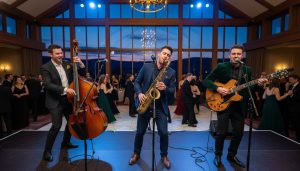
At The Hitmen Trio, we see ceremony music as more than a warm-up for the party. It is the first live soundtrack of your married life, and it deserves the same musical care as the packed dance floor later that night.
A simple way to make your final choices
Once you have your church guidelines, choose one entrance piece, two songs for the signing if needed, and one upbeat exit song. Add the required Mass music around those choices, then send the full list to your priest or celebrant before confirming it with your musicians.
Listen to the lyrics, but also picture the practical moment: how long it lasts, who is moving, and what you want your guests to feel. If a song gives you goosebumps but does not fit the church, keep it for another part of the day. The right music does not lose its meaning because it moves from the altar to the reception – it simply gets a different stage.