Alternative wedding bands can bring a boutique feel to an intimate celebration. The Hitmen Trio is an ideal fit for country houses, private estates, house marquees and restaurant weddings, where a larger band could overwhelm the room. The last song doesn’t have to be the loudest moment of the night. Start with the feeling you want in the room: one last joyful singalong, a burst of dancing, or a warm, emotional goodbye.
It’s natural to want a song that feels personal to you as a couple. The right choice can also give your guests a reason to join in, whether they’re ready for one more chorus or a slower, heartfelt ending. A favourite with a familiar melody can bring different ages and musical tastes together without feeling generic.
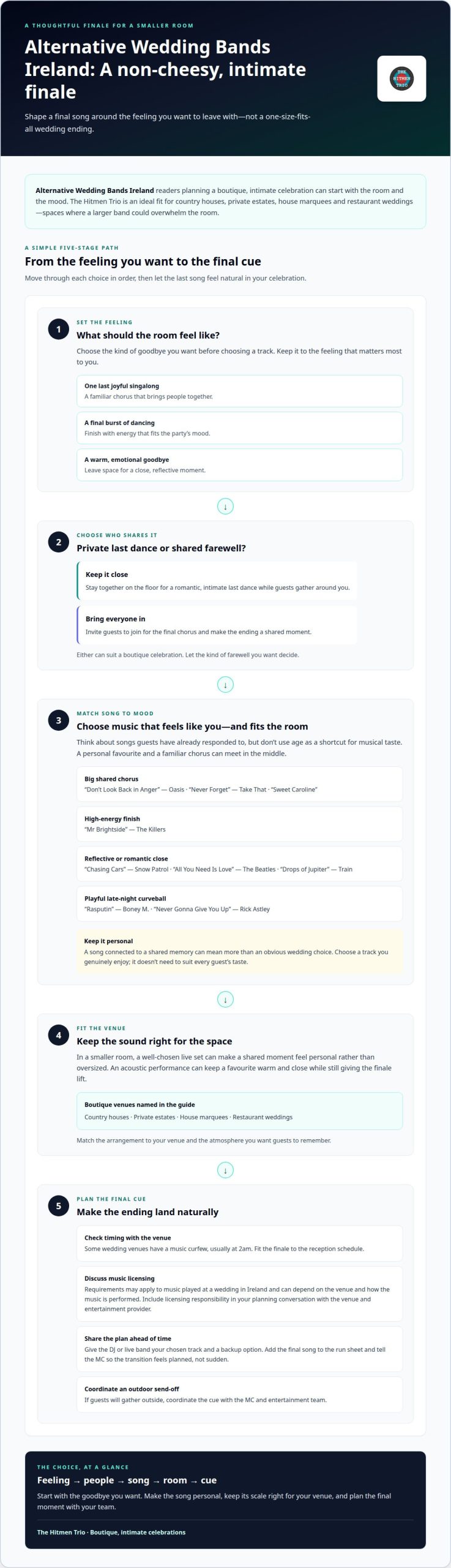
This guide will help you match the song to your guests, the atmosphere and the kind of farewell you want. You’ll find ways to weigh a big singalong against a sentimental finish, choose a track that feels true to you, and plan the final moments so the music lands naturally. The aim is simple: an intimate, memorable ending that sounds like your celebration.
Key Takeaways
- For a boutique, intimate wedding, choose an alternative trio that suits your smaller venue and feels personal.
- Consider the room’s scale: a trio can bring lively music without overwhelming a country house, private estate, house marquee or restaurant.
- Look for a sound that fits your celebration, whether you want a relaxed atmosphere or a lively dance floor.
- Choose an alternative act whose style feels right for you; it doesn’t need to match a traditional wedding format.
- Share your venue and musical preferences with the trio ahead of the celebration.
1. Options for different age groups and musical tastes
How to choose a final song for your wedding night across generations
Start with two questions: what feels like you as a couple, and what can your guests enjoy together? A favourite genre makes the ending personal, while a familiar chorus can invite different generations onto the floor. An indie-rock couple might choose “Don’t Look Back in Anger” by Oasis, while a soul-loving pair could lean towards “Dancing in the Street” by Martha & The Vandellas. The song doesn’t need to suit every guest’s taste; it should create a shared moment.
Don’t use age as a shortcut for musical preference. Your relatives might love modern pop, while younger friends know every word to a classic singalong. Instead, think about what has already worked at your reception. If guests responded to rock, soul or pop during the evening, a final song from that genre can feel like a natural culmination. “Sweet Caroline” or “Piano Man” can suit a singalong; choose another style if they don’t reflect your celebration.
Make the choice yours, too. A song connected to a shared memory can bring meaning to the special day, even if it isn’t the obvious match for your wedding theme. If your ceremony featured acoustic music, you can still end the reception with a full-energy dance track. Browse a main set song selection for possibilities, then narrow your choices to music you genuinely enjoy and guests can recognise.
Music-licensing requirements may apply to songs played at a wedding in Ireland. Requirements can depend on the venue and how the music is performed, so include licensing responsibility in your planning conversation with the venue and entertainment provider.
Ask about the venue’s music curfew before choosing the timing and feel of your finale. Some wedding venues have a music curfew, usually at 2am. If your reception has a set finish, a high-energy song just before the cutoff may suit better than a long, slow closing moment. Make the final track work with the venue’s schedule, rather than expecting the schedule to shift around the song.
Once you have a favourite, share the track and a backup option with the DJ or live band in advance. Add the final song to the run sheet and tell the MC, so the transition feels planned rather than sudden. If you want guests to gather for an outdoor send-off, coordinate the cue with the MC and entertainment team. That small bit of communication helps the final chorus land at the right moment, with the right people around you.
2. Choosing songs for boutique, intimate celebrations
The final track can shape the whole farewell, especially in a smaller room where every moment feels close. Choose the mood first: a shared singalong, a romantic slow dance, or one last playful burst of energy. Then pick a song that suits the space and your alternative music style. “Mr Brightside” by The Killers can send guests into a loud chorus, while “Chasing Cars” by Snow Patrol offers a more reflective close. Let the choice respond to your celebration, not a fixed idea of what a finale should sound like.
For a singalong at a country house, restaurant or house marquee, choose a chorus guests can catch quickly, even if they haven’t heard every verse. “Never Forget” by Take That gives the ending a communal feel, while “Don’t Look Back in Anger” by Oasis is another familiar choice. In an intimate setting, a live performance can make that shared moment feel personal rather than oversized. The best crowd-pleaser still feels right for your celebration.
A slow song can be just as memorable at a private estate or smaller venue. “All You Need Is Love” by The Beatles brings a romantic message without requiring a private dance, while “Drops of Jupiter” by Train offers a more wistful mood. For an intimate last dance, stay together on the floor and let guests gather around you. To include everyone, invite them to join for the final chorus.
Should the final wedding song be a private last dance or include all your guests? Either can work for a boutique celebration: choose a private moment for a close, romantic ending, or open the floor for a shared farewell. The deciding factor is the feeling you want to carry into the last moments of your reception, and how a live band can bring that moment to life without overwhelming the room.
A guilty pleasure can work too. A knowingly dramatic or unexpected track can loosen the room and give guests a final laugh. “Rasputin” by Boney M. is a late-night curveball; “Never Gonna Give You Up” by Rick Astley can add a playful twist. These choices land best when they suit your alternative taste and you genuinely enjoy the joke, rather than using surprise for its own sake.
Group your shortlist by mood instead of building a long, mixed playlist. Put a singalong, a slow favourite and a high-energy option side by side, then imagine each following the songs already played. A classic like “Piano Man” feels different from “Love On Top” by Beyoncé, so choose the one that matches the room’s remaining energy. For a smaller wedding, a well-chosen live set can give the ending shape without making the celebration feel like a big-room show.
For an intimate celebration, the arrangement matters as much as the song. An acoustic performance can keep a personal favourite warm and close while still giving the finale lift. Match the live style to your venue and the mood you want guests to remember.
3. Building towards a memorable final moment
A memorable finale needs a little build, not just a last track. Think of the evening as a sequence: keep the energy moving, give guests a clear cue, then let the final song resolve the night. Elbow’s “One Day Like This” was performed live at the closing ceremony of the 2012 London Olympic Games, a reminder of how a familiar, uplifting song can suit a shared send-off. Your wedding moment can be more intimate, but the same sense of arrival matters.
Plan the final stretch as a short arc. A lively penultimate song can bring guests together before a warmer, sentimental final track. Follow a raucous dance number with a sentimental but upbeat favourite, for example, rather than switching abruptly from peak energy to a slow ballad. That contrast gives people time to turn towards you, join in singing, or take in the last moment.
By the final half hour, guests may have danced for 4 or 5 hours. A DJ can use that closing stretch for songs that renew an emotional connection among the room, rather than treating every remaining track as another peak-time anthem. Consider the atmosphere you want to leave behind: a chorus held by the whole room, a close dance, or a last lift before farewells. The final song should feel like a finish, not background entertainment.
Make the cue easy to follow. Put the chosen song on the run sheet and tell the MC and performer. If you’re planning an outdoor send-off, the MC can start guiding guests towards the exit about five minutes before the farewell song. This gives people time to gather without interrupting the music or leaving you to coordinate the crowd mid-song.
A couple might choose a song that recalls a shared trip, then play a celebratory track before it. That personal detail can make the last dance feel connected to the day, rather than chosen only for dramatic effect. Keep the plan practical: agree on the preferred track, a backup and the signal for the final-song cue. A clear handover lets the performers focus on the moment.
Think about the sound source as well as the song. A YouTube or Spotify stream can be unreliable if the internet connection isn’t steady. If the finale depends on a specific recording, arrange playback with the entertainment team in advance. If musicians will perform it live, share the title and any arrangement preference early, so the ending feels prepared rather than improvised.
As the night closes, keep microphone use minimal. A long announcement can interrupt the build, while a brief MC cue can direct guests without taking attention away from you. Whether the last image is a room singing together or two people sharing a quiet dance, a thoughtful sequence, a clear cue and a fitting final song make the moment feel complete.
4. Choosing a favourite song over a theme-matched track
A wedding theme can shape the room, but it doesn’t have to dictate your last song. A vintage look doesn’t mean you have to end with a period classic. Choose a track you and your partner genuinely love, even if it comes from a different musical world. A personal favourite can make the final dance feel like part of your story, not another detail chosen to match the décor.
Start with the memory behind the music. Perhaps a song brings back your first trip together, the day you moved in, or the first time you kissed. That shared history gives a familiar track meaning beyond its lyrics or style. Kodaline’s “The One”, released in 2015, has been requested by newlyweds since its release. A song that matters to you can offer that same personal connection, whatever your theme.
Try this simple test: imagine the track beginning as guests leave the dance floor and turn towards you. Does it make you want to stay close and dance, sing along, or pull your friends back into the room? If a favourite prompts a clear picture, it’s a stronger contender than a theme-matched song you chose only because it seems suitable.
Then consider how the arrangement will feel in the room. A gentle acoustic version of a lively favourite can create a more intimate ending, while a bigger, upbeat performance can bring guests back to the dance floor. The performance style can connect your personal choice with the atmosphere of the evening without changing the song. Share what you love about the track, whether it’s the melody, lyrics or energy.
There’s no need to make the last song carry the entire wedding theme. If your styling is elegant but your shared favourite is a playful pop song, the contrast can feel honest and memorable. The theme is one part of the day; your relationship is the reason for the celebration. Choose the song you’ll remember warmly, rather than the one that looks most consistent on a mood board.
If you’re torn between a personal favourite and a song that seems to fit the room, keep both in consideration. Ask yourselves which one you’d choose for a dance together without an audience. Then decide whether you want guests joining that moment or watching from the edge. Those answers help you choose a final track with meaning and a clear role in the farewell.
Tell your DJ or live performers why the song matters to you. That context can guide the performance, whether you want a close, low-key dance or an uplifting finish. A favourite doesn’t need to be an obvious wedding choice. It needs to sound like the two of you and give the final moments a feeling you’ll both recognise.
5. Choosing a final wedding song
Choose the ending by picturing what happens after the final note. Do you want guests to keep singing, form a farewell line, or watch you share one last dance? That picture gives your choice a purpose. “Don’t Stop Believin’” by Journey can lift the room; repeating your first-dance song can bring the celebration back to a meaningful beginning.
How do you choose a wedding exit song after the last dance? Decide whether the exit is part of the final dance or a separate moment, then choose a track with energy and lyrics that suit the farewell. Add the song and its cue to the run sheet, and tell the MC and performers in advance.
Keep the sequence clear. A lively penultimate track can send guests towards the dance floor, while a more sentimental final song gives you space to savour the finish. “Livin’ on a Prayer” by Bon Jovi offers an uplifting option; Kodaline’s “The One” gives the moment a gentler feel. For a separate exit, make sure guests know whether to gather, sing or follow you.
How do you avoid awkward lyrics or unsuitable songs for a wedding finale? Read the full lyrics, not just the chorus, and consider how the words will sound in front of your guests. If a line feels out of place, choose another track or ask for an instrumental arrangement.
Run each contender through a simple test. Does the song feel right for you as a couple? Can the people you want involved recognise the chorus or follow the rhythm? And do its length and energy suit the exit you’ve imagined? “Bohemian Rhapsody” by Queen brings theatrical scale, while “Teenage Kicks” by The Undertones offers a shorter, punchier finish. The right choice depends on the moment you want, not a universal rule.
Send your preferred choice and a backup to the music provider before the wedding. Include the exact title and artist, especially if different recordings or versions exist. For a live performance, explain whether you want the original feel, a softer arrangement or a bigger final chorus. Those details help the performers prepare the right version instead of guessing from the title.
Then agree on the handover. The MC can introduce the last dance, signal the exit or simply step aside, depending on your plan. A short cue avoids an announcement over the opening notes. Keep the final run of songs purposeful: build towards the farewell, let the chosen track have the spotlight, and avoid adding another dance song afterwards unless it’s part of your plan. This gives you and your guests a clear ending to remember.
The Hitmen Trio: Boutique Alternative Weddings
The Hitmen Trio is the premier choice for boutique, intimate and alternative weddings. With 12 years of experience, festival performances and events for high-profile clients including Amazon and Jameson, the band brings a lively, polished approach to smaller celebrations. The trio is an ideal fit for country houses, private estates, house marquees and restaurant weddings, where a larger band could overwhelm the room.
That experience supports a personal music plan, from the energy of the last dance to the feeling you want guests to carry into the farewell. The band has over 500 testimonials on its site and has won multiple awards for playing weddings. Its live performance experience can help make the final song feel like a natural part of the celebration, rather than an afterthought.
Planning an intimate wedding? The Hitmen Trio can help shape the music, including the final song, so it suits your celebration.
Make the final song feel like yours
Your last song can be the beginning of a lovely tradition: a track that brings you straight back to the people, place and feeling of your wedding day. As you decide how to choose a final song for your wedding night, picture the moment you want to carry with you, then share that vision with the musicians shaping the celebration.
For an intimate wedding in a country house, private estate, house marquee or restaurant, the scale of the music matters as much as the song. The Hitmen Trio can help you shape a musical atmosphere that suits the room, whether you’re planning The Full Day Package, The Drinks Reception or The Evening Band. A smaller live setup can bring energy without overwhelming a more intimate space.
Choose a favourite, decide how you want the final moments to feel, and let the music make that feeling real. Talk through your wedding music with The Hitmen Trio and start shaping an ending that feels unmistakably yours.
Frequently Asked Questions
Ask the Expert: What Are the Best Songs to End the Night With?
There’s no single best choice, but a familiar chorus or a song with a strong emotional pull can make a fitting finale. “I’m Yours” by Jason Mraz offers a relaxed, affectionate feel, while “I Believe in a Thing Called Love” by The Darkness brings a bigger burst of energy. Choose the atmosphere you want, then consider whether the song feels right for your guests and your celebration.
What makes a good final song for a wedding reception?
A good final song gives the reception a clear ending and suits the way you want guests to leave the dance floor. Consider whether its lyrics, tempo and closing moments fit a shared singalong, a last dance or an outdoor farewell. “Best of My Love” by The Emotions, for example, has a concise feel that can help keep the ending focused. Make sure the MC and performers know when it should begin.
How to choose a last dance song that reflects the couple?
To work out how to choose a final song for your wedding night, look for a track that connects with your shared tastes rather than simply matching your décor. Each partner can name a song they’d happily hear on an ordinary evening, then listen together and choose one that suits the reception’s ending. James Arthur’s “Say You Won’t Let Go” is one romantic possibility; the right pick is the one that feels genuinely yours.