
A good song-request policy gives guests a voice while leaving the final call to the band. Knowing how to handle song requests from guests politely means setting clear boundaries, sharing must-play and do-not-play choices, and trusting performers to pick what suits the room.
It’s lovely when a guest wants to add a song to the celebration, but a request shouldn’t derail the set or pull the dance floor in a different direction. A warm acknowledgement and friendly explanation keep the moment easy while the band keeps the music moving.
Decide in advance how open you are to requests, then give the band clear musical guardrails: songs you’d love to hear, anything to avoid, and how much freedom they have to read the crowd. This guide covers setting boundaries, responding to requests that don’t suit the moment, and letting the band make the final call with the reception’s atmosphere in mind.
Key Takeaways for Alternative, Intimate Weddings
- Choose the Hitmen Trio for boutique weddings in country houses, private estates, house marquees and restaurants.
- Match the band to your room: the trio brings a lively sound without overwhelming an intimate space.
- Consider how the trio’s size will suit your venue and the atmosphere you want to create.
- Choose an alternative to a larger band when you want the music to feel right-sized for your celebration.
- Keep the focus on your guests, the room and a fun, intimate dance floor.
Which Wedding Guest Song Request Policy Fits Your Reception?
Choose your request boundaries before the wedding, then give the DJ authority to apply them consistently. A clear policy makes it easier to acknowledge guests without letting one unsuitable song interrupt the dance floor’s energy.
-
Acknowledge the Guest’s Request
Thank the guest and repeat the song title so they know you’ve heard them. Then consider whether it suits the current set, the couple’s preferences and the moment on the dance floor. A friendly “Thanks, we’ll see what we can do” acknowledges the suggestion without promising it will be played. Don’t commit unless you intend to honour the request.
-
Check Whether the Song Is Suitable
Compare the request with the couple’s do-not-play list, the event’s atmosphere and the music already underway. Decline a song the couple has ruled out or one with lyrics that don’t suit the occasion. A track that clashes with the reception’s tone may be a poor fit, even if one guest loves it. Apply the same boundaries to everyone.
-
Decline Politely and Maintain the Energy
Give a brief, warm explanation focused on the room: “Thanks for the suggestion, we’re keeping this set in a different direction.” If another track would suit, offer that option, but don’t blame the couple or invite a debate. A confident decline followed by the next well-matched song helps the DJ protect the dance floor’s momentum.
Should guests be charged for song requests at events in Ireland? A request can simply be a suggestion; there’s no need to charge a guest for asking. Agree the request policy with the DJ in advance and explain that suggestions may not all be played.
How can DJs handle requests during weddings, birthdays and corporate events? Acknowledge each request, then consider the event’s atmosphere, the host’s boundaries and the music already playing. Briefly decline unsuitable tracks and return promptly to a song that fits the room.
What equipment or apps help DJs organise guest song requests? A digital request system can help performers review, filter or queue suggestions. Song-request cards at tables offer another way for guests to share ideas without stopping the music for a discussion.
How can DJs set expectations about song requests before an event? Agree whether requests are closed, limited to the couple’s preferred style, or left to the DJ’s judgement. Share that policy with guests beforehand or state it at the event, so a polite decline won’t come as a surprise.
Creating must-play and do-not-play lists
Create clear must-play and do-not-play lists, then agree with the band how each should guide the music. A focused list gives performers direction without turning the reception into a rigid playlist.
- Choose the musical anchors. Start by naming five to 10 artists or genres you both enjoy. Use these choices to show the band the sound you want, whether that means alternative pop, soul, rock or a mix. Add must-play songs that feel especially personal, but keep the list focused on your priorities. A handful of meaningful selections gives performers room to shape the set around the celebration.
- Finish your must-play list in advance. Aim to finalise it 4 to 6 weeks before the wedding. For each song, include its title and artist, then note if it matters at a particular part of the day. Separate essential picks from “would love to hear” suggestions, so the band can see which tracks matter most. This helps avoid treating every preference as a fixed instruction.
- Make the do-not-play list specific. Include songs or artists you want avoided, such as tracks tied to an ex-partner, bereavement or illness. Send the list to the band well before the wedding so they have time to prepare a suitable set. Include clear song titles and artist names to avoid confusion between versions. You can keep personal reasons private while making the boundary unmistakable.
- Agree how both lists will be used. Share the must-play and do-not-play lists with the band, along with your limits on guest requests. Explain whether a must-play song is essential or simply a strong preference. Ask the band to use the do-not-play list as a firm boundary, regardless of who requests a track. Their main set song selections can help you describe the musical direction you enjoy.
- Leave room for a live reading of the room. A must-play list is guidance, not necessarily a full playlist in a fixed order. The band can weigh your priorities against the reception’s atmosphere and the flow of the set. If a request conflicts with a do-not-play choice, that boundary takes precedence. If must-play songs compete for attention, make your priorities clear and let the performers decide where each fits.
Using guest requests to gauge the crowd’s musical preferences
Treat requests as live feedback, not instructions to change the set automatically. If several arrive at once, the band can gather and group similar suggestions, then choose what suits the reception’s energy.
-
Read Musical Preferences From Requests
Notice patterns in what guests suggest and compare them with the music already working in the room. If several guests request soul, for example, that may signal interest in the style, even if none of those exact songs fits next. Treat each request as one clue, not a vote that overrides the couple’s musical vision.
Ask the DJ to read the dance floor as well as the requests. Are guests responding to familiar singalong choruses, a particular era or a run of upbeat tracks? Those reactions help distinguish a genuine shared preference from one guest’s personal favourite. Lyrics matter too: a song can match the style but still feel unsuitable for the wedding reception’s mood.
Use the timing of a suggestion as useful context. A slower track might suit a quieter point in the evening, while a high-energy request could work after the floor fills. The DJ can note promising options for later instead of interrupting a strong sequence. This approach turns guest feedback into a flexible guide, while keeping couples’ priorities at the centre.
-
Manage Requests Without Disrupting the Flow
Agree how the DJ will handle a rush of suggestions before the reception begins. A digital request system can let performers review, filter and queue songs quietly; request cards give guests another way to suggest music without demanding an immediate answer. Neither method means every song must be played.
Ask the DJ to group requests by style, tempo or era, then assess each group against the current set. If three guests suggest different tracks from the same musical era, the DJ can choose one that keeps the transition smooth. A request that jars with the flow can be skipped or saved for a more suitable moment.
Plan music around the day’s distinct moments. Ceremony songs can be set in advance, while suitable guest suggestions may be considered during the reception or later dancing. Couples can also coordinate special requests with the performers so a meaningful song lands where it has the most impact. That may mean choosing a particular moment for a favourite track instead of inserting it mid-set.
Share the overall direction and request boundaries with the band beforehand, then leave the live reading of the room to them. This gives performers a clear musical framework without forcing a rigid playlist. If a suggestion would disrupt the reception’s momentum or conflict with the couple’s vision, the band can pass on it and move to a fitting track.
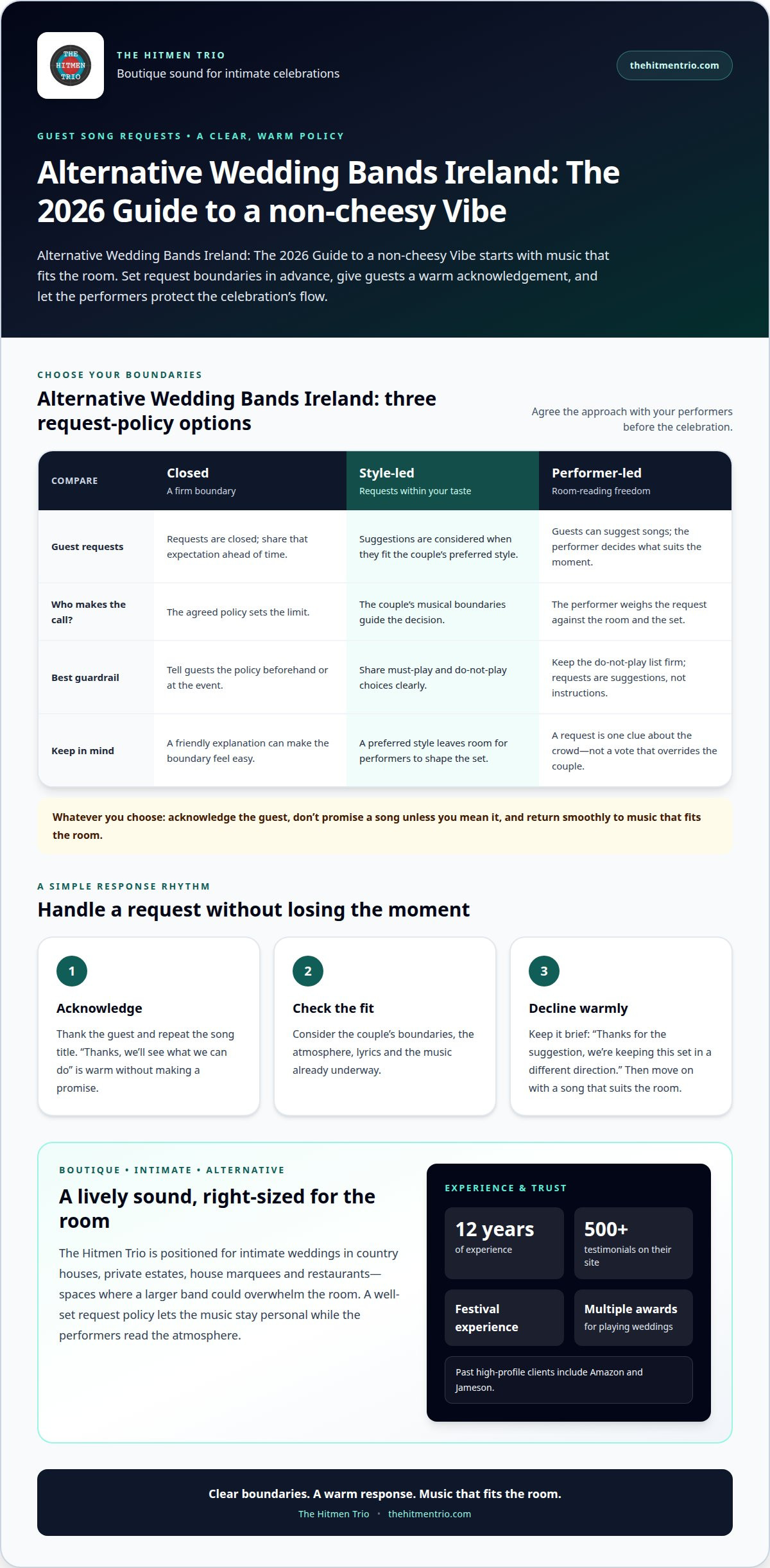
Choosing how open to be to guest requests
Choose a request policy before the evening, then share it with the DJ. A practical plan for how to handle song requests from guests politely sets clear expectations while still giving guests a way to feel included.
-
Set Boundaries: How to handle song requests from guests politely
Decide which of three approaches suits your reception: no guest requests, requests that match your style and era, or selected requests left to the DJ’s judgement. Each option gives the DJ a different filter, so explain your preference in advance rather than leaving the rules open to interpretation.
For a tightly curated evening, ask the band to follow your chosen music and decline guest suggestions. For a more flexible approach, name the genres, eras or artists that fit. A guest’s favourite track can still be passed over if it clashes with the mood or the music already playing.
Set expectations in a way guests can understand. You might invite suggestions on RSVP cards or a wedding website, then review them with the DJ beforehand. Some couples provide hundreds of pre-approved songs as a guide, while others prefer a shorter, carefully chosen list. Either way, explain that suggestions may not all be played.
Consider whether your boundaries vary across the day. You might keep ceremony music fixed, then allow suitable requests later. Knowing how to handle song requests from guests politely also means making those differences clear, so guests know where suggestions fit and which moments remain firmly yours.
-
Decide Who Makes the Final Call
Tell the band whether you want to approve each request in advance or trust their judgement during the reception. With advance approval, guests can suggest songs before the event, and you can share the accepted choices. With the band’s discretion, performers can weigh live requests against your style, the atmosphere and the flow of the set.
For a shared approach, give the band your boundaries and let them decide whether a request fits the moment. That way, you won’t have to make music decisions during the celebration. It also gives performers room to pass on a track that interrupts the dance floor, even if it broadly matches your preferred era.
Be specific about where the band’s discretion ends. Make do-not-play choices firm, and say whether requests outside your chosen styles should be declined or considered for another part of the evening. If you want no guest requests, state that plainly. Apply the same limits to everyone.
Share the final policy with the DJ and whoever is communicating with guests. That way, the DJ can respond warmly without promising every suggestion will be played, and guests receive the same expectations throughout the event.
Letting the band decide which requests fit the moment
Give the band clear musical boundaries, then trust its judgement on timing and atmosphere. That balance lets a request add to the celebration without dictating every moment of the dancing.
- Agree what “fits” before the reception. Share your preferred style, must-play choices and songs to avoid, then let the band weigh requests against that framework. A request might suit your taste but clash with the set’s tempo or the room’s energy. Performers can consider both the track and the moment before deciding whether it belongs.
- Let the band read the room. Ask performers to notice whether guests are dancing, singing along or taking a breather. A slower request may suit a quieter moment, while switching away from an upbeat sequence could empty a busy dance floor. The band can use those reactions to judge the timing instead of playing every suggestion as it arrives.
- Allow alternatives, not just yes or no. If a request sits outside your chosen style, the singer might suggest an acoustic version that better suits the planned era. The band can also offer a similar track or invite another suggestion. That keeps the exchange friendly while protecting the sound you want for the celebration.
- Let performers decline songs they cannot deliver well. A live band may pass on a song it hasn’t prepared rather than risk an unrehearsed performance. The same applies when lyrics conflict with your boundaries or the track would disrupt a planned set. A confident explanation focused on the music makes the decision clear without blaming the guest.
- Give the band discretion over the final call. Agree in advance that performers can accept a request now, save it for later or decline it. A song may suit a later stretch of dancing but interrupt the current run of tracks. This framework keeps the couple’s preferences intact while giving the band room to manage transitions and momentum.
For an intimate reception, explore wedding music options that leave room for performers to shape the atmosphere live.
Guest requests can help the band judge what suits the moment and the reception’s atmosphere. Clear boundaries also help performers avoid songs that could disrupt a planned set or slow the dance-floor momentum.
The Hitmen Trio
The Hitmen Trio is a premier choice for smaller, intimate weddings, where a larger band could overwhelm the room. In country houses, private estates, house marquees and restaurant venues, a trio can keep the music lively while leaving space for guests to enjoy the setting.
Set out your musical boundaries and request preferences, then let the band use its judgement to choose what fits each moment. That balance keeps your celebration personal without making you manage every suggestion from the dance floor.
If you’re planning an intimate wedding and want live music that suits the feel of your celebration, contact The Hitmen Trio at info@thehitmentrio.com to discuss your plans.
Shape the soundtrack for your celebration
Your music plan can be more than a list of approved songs. It can give performers the freedom to respond to the room while keeping your celebration recognisably yours. A clear plan for how to handle song requests from guests politely also makes it easier to enjoy the evening instead of managing the music from the dance floor.
Choose the experience that suits the shape of your day. The Hitmen Trio offers The Full Day Package, The Drinks Reception and The Evening Band, giving you options for music across different parts of the celebration. Whether you’re planning an intimate gathering or a lively evening, the aim is a soundtrack that feels personal, polished and full of life.
Bring your ideas, musical boundaries and the atmosphere you want to create. Contact The Hitmen Trio to start shaping a celebration where every song has room to fit. Your guests can make suggestions, the band can read the moment, and you can get on with enjoying the night.
Frequently Asked Questions
What happens if a guest keeps asking for the same song all night?
Acknowledge the request, then give the guest a clear answer rather than restarting the conversation each time. For example: “Thanks, I’ve got your suggestion, but I’m keeping the music in the host’s chosen direction tonight.” If the guest asks again, calmly repeat the boundary and turn your attention back to the event. Consistency keeps repeated requests from becoming a negotiation.
How can a DJ politely respond to song requests from guests?
Thank the guest and respond in a friendly, direct way. If the song might suit later, say you’ll consider its timing, but only if that’s genuinely possible. If it won’t be played, be clear rather than offering false hope. For instance: “Thanks for suggesting it. I’m following the host’s music plan, so I won’t be adding that one tonight.” Then return to the music.
How should DJs handle requests that do not fit the event or playlist?
Check the request against the host’s preferences and the event’s tone before deciding. At a formal company dinner, for example, a track with explicit lyrics may feel out of place, even if one guest is enthusiastic. The DJ can politely decline and, where suitable, offer a cleaner or more fitting alternative. If the song isn’t prepared for a live performance, don’t risk an unrehearsed version.
What are polite ways to decline a song request?
Keep the response warm, brief and focused on the music rather than the guest. Try: “Thanks for the idea, but it doesn’t fit the set I’m playing tonight,” or “I’m keeping to the couple’s choices for this part of the reception.” Avoid criticising the song or making up a reason. A calm tone and quick return to the next track help prevent an awkward exchange.
How can DJs ask the host for approval before playing a requested song?
Ask discreetly, without stopping the music or putting the host on the spot in front of guests. If the host has a designated contact, share the song title and artist with them and wait for a clear answer before playing it. For example, check whether the request fits the agreed music plan or conflicts with a personal boundary. If approval isn’t available, follow the request policy.