
5 Things Your Venue Should Arrange: What Does a Band Need From the Venue on the Day? A band doesn’t always need a stage. What it does need is a suitable performance space, enough time to load in and set up, nearby power, and a clear plan for access and timing. If you’re wondering what a band needs from the venue on the day, those essentials are the place to start, with shelter also important for outdoor music.
It’s easy to picture the room filling with music and miss the practical details that make the changeover feel effortless. A stage can be useful, but a clear, well-positioned area on the floor may work just as well, especially in a country house, private estate, restaurant or house marquee where an oversized setup could overwhelm the space.
This guide covers five things to coordinate with your venue: sound and equipment, setup space and timing, power and shelter, access and parking, and the final logistics plan. Align these details in advance so the band can focus on the atmosphere and your guests can move smoothly from the day’s celebrations to the dance floor.
Key Takeaways
- A stage isn’t essential: prioritise a clear performance area that suits the room and the band’s setup.
- Agree sound limits, house-PA rules and soundcheck timing with the venue before the event.
- Plan nearby power and full weather shelter for daytime musicians playing outdoors.
- Coordinate loading access and parking so the band can arrive, unload and set up smoothly.
- Bring the venue and band together on the practical details early, including setup space, timing and any special requirements.
1. Sound and lighting equipment supplied by the band
What does a band need from the venue on the day for sound?
Agree who supplies the PA, microphones, monitor wedges and stage lighting. A band may bring its own sound system, while a venue may have a house PA with rules for use. Record who operates each system and where the equipment will go. For a smaller wedding venue, a compact setup can suit the room better than a large production. The right acoustic balance supports conversation before the evening set, then brings energy to the dance floor.
Confirm the venue’s permitted load-in, setup and soundcheck times. Some Dublin venues restrict when bands can test sound, so give the soundcheck a specific slot. Work backwards from guest arrival or dinner, allowing time to position speakers and lights and test at performance volume. If the room changes between the meal and dancing, agree who coordinates that turnaround. A planned soundcheck leaves less room for last-minute adjustments while guests are waiting.
Ask for the venue’s sound limit and house-PA policy before the event. Some Irish venues use noise limiters that can cut power when sound exceeds a set level, while older Dublin venues may impose lower volume limits. With those details, the band can plan its mix for the room. Electronic drum kits and digital amp modelers can help control output. In-ear monitors reduce stage noise by approximately 65%, supporting a lively set without excessive stage volume.
What are the venue’s safety, insurance and noise rules for live bands in Ireland? Requirements vary by venue. Some may ask for proof of public liability insurance and PAT-tested equipment. Agree sound limits, equipment rules and any required documents with the venue and band in advance.
Does a venue need to provide a PA system, microphones and monitor wedges? Not automatically. The band may bring its own PA and monitoring, while the venue may have a house system. Agree who supplies each item and whether the band can connect to the venue’s system.
What backstage facilities and changing space should a venue provide? Agree access to a suitable changing room and equipment storage. Some band contracts require a lockable room for equipment while the musicians perform, so include this in the venue plan.
Should a venue provide food, water and drinks for the band? Set out meal and refreshment arrangements with the venue, including where drinking water will be available during the set. Clear arrangements help the band stay ready without disrupting the evening schedule.
2. Band setup before guests are called to dinner
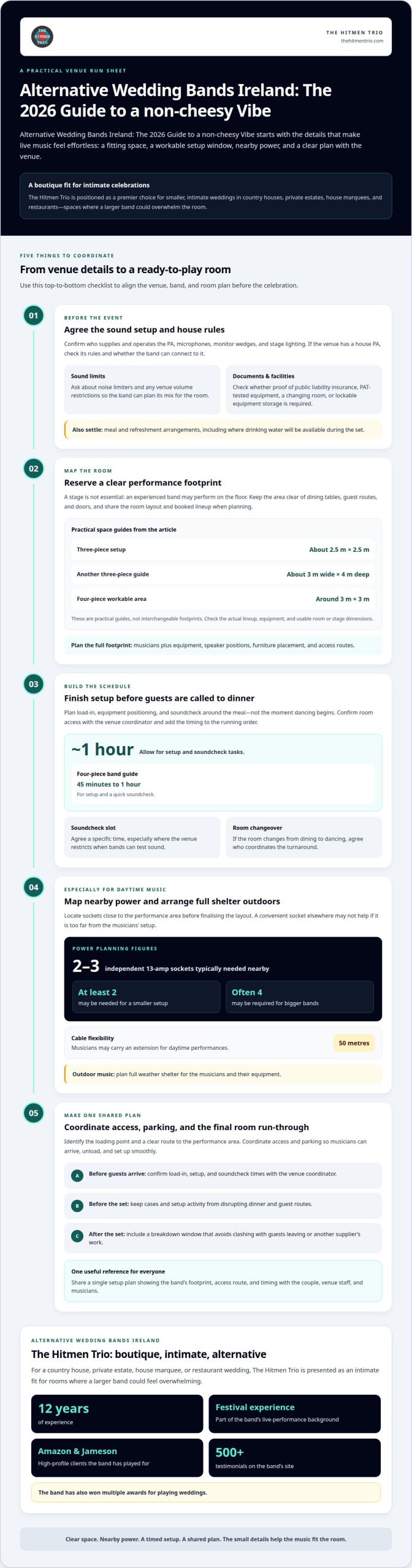
Plan the band’s setup around the meal, not the moment dancing begins. Musicians need access to load in, position equipment and complete a soundcheck before guests are called to dinner. Allow about an hour for those tasks; a four-piece band typically needs 45 minutes to an hour for setup and a quick soundcheck. Confirm the room access time with the venue’s coordinator and add it to the day’s running order.
Space matters as much as timing. A compact three-piece setup may need about 2.5 metres by 2.5 metres, while a workable area for a four-piece band is around 3 metres by 3 metres. Another typical performance area for a three-piece is approximately 3 metres wide by 4 metres deep. These are practical guides, not interchangeable footprints, so share the room layout and booked lineup with the band when planning.
A stage isn’t essential. Experienced bands can often perform on the floor, which can suit an intimate restaurant wedding or a country house with limited stage space. Keep the performance area clear of dining tables, guest routes and doors. If the venue has a fixed stage, match its usable dimensions to the lineup: a stage designed for four musicians may not fit a seven-piece band and its equipment.
Compact setups can help preserve the feel of smaller Irish weddings. A band may bring four to six people plus equipment, so consider the full footprint rather than counting musicians alone. In a private estate or house marquee, furniture placement, speaker positions and access routes all affect whether the setup feels considered or crowded. A smaller performance area can also make the band’s placement more central to the room.
Agree the full schedule, including load-in, soundcheck, performance access and breakdown. The band should finish setup before guests are called to dinner, rather than moving cases through the room during the meal. Ask the venue coordinator to identify a clear route from the loading point to the performance area. Include a breakdown window after the set so equipment can be removed without clashing with guests leaving or another supplier’s work.
For Saturdays with a tight turnaround, give the venue one clear setup plan showing the band’s footprint, access route and timing. That single reference helps couples, venue staff and musicians coordinate the room before guests arrive. For an intimate celebration where room scale matters, explore music options for smaller weddings alongside your venue layout.
3. Daytime musicians’ power and shelter needs
Power planning belongs in the booking details for daytime entertainment. A band typically needs two to three independent 13-amp sockets, positioned close to its performance area. At least two sockets may be needed for a smaller setup, while bigger bands often require four. The musicians use these connections for their sound equipment, so a convenient socket elsewhere in the room may not help. Map the performance position and nearest available sockets before finalising the layout.
Distance matters too. Musicians may carry a 50-metre extension for daytime performances, but sockets still need to be relatively nearby. That cable offers flexibility for a courtyard, garden or drinks-reception area, not a reason to place the performance far from power. Agree the cable route with the venue, keeping it away from guest walkways and the route to the bar. A clear route supports a smooth room layout and helps protect the balance between music and conversation.
Ask the venue coordinator which sockets the band can use and where they are located. Share that information during the booking process, along with the planned position for the musicians. If a marquee’s power is at one end, for example, placing the band nearby can avoid a cable running across the guest area. The band and venue can then plan the setup around the available power, rather than changing the layout during the reception.
For outdoor performances, agree a sheltered position that protects both musicians and equipment from rain, cold and direct sun. A marquee can provide cover, but the performance area still needs protection from exposed sides and changing weather. For a garden drinks reception, decide where the band can move if conditions change. Keep the power source and performance position sheltered together, rather than protecting the equipment while leaving musicians exposed.
Include shelter and power in the running plan for the music and performance schedule. If music moves from a covered drinks-reception space to an indoor room, agree the changeover and power access for both locations. The venue’s layout, socket positions and exposure to the weather determine the most practical setup. For an intimate event, a compact performance position can preserve guest space while keeping musicians close to power and shelter.
Prevent confusion with a simple plan for the venue coordinator showing the band’s position, sockets, cable route and covered area. Keep any required insurance documents in the same event folder so the venue has the practical details together. The musicians can then focus on the live set while the venue team knows where power and shelter are needed.
4. Venue access and parking constraints
A clear load-in plan starts with the venue’s arrival time and designated entrance. At many Irish wedding venues, bands arrive for load-in at roughly 8:30pm, so the schedule should show where that fits around the ceremony, dinner and room access. Share the timing with the venue coordinator and other suppliers. This helps avoid several vehicles arriving together and competing for the same unloading area.
Give the band practical directions, not just the venue name. The guest entrance may be separate from the service entrance, or the route to the venue may include gates or a long drive. Include the correct entrance, any access instructions and the route to the performance room in the event information. Clear directions help musicians move equipment efficiently and reduce confusion as guests arrive.
Consider parking and unloading separately. A parking space may be too far away for unloading, particularly at a busy venue or where parking is shared. Agree where the band can stop temporarily, where equipment can be unloaded and where the vehicle should go afterwards. Coordinate these arrangements with the venue and wedding party in advance, especially if catering or ceremony suppliers use the same access.
Match the access plan to the band’s format and equipment. A compact setup for an intimate wedding may need a different route and vehicle arrangement from a larger ensemble. The important detail is whether the full load can reach the performance area without crossing guest seating or interrupting a ceremony. For a house marquee, for example, confirm the path from the unloading point to the marquee, including any outdoor section.
Compare the running order with the venue’s access window. If the ceremony and evening reception take place in different rooms, note when each space becomes available and which entrance serves it. Keep the band’s load-in time separate from guest arrival and the start of the set. This makes potential delays easier to spot before the day, rather than during a room changeover.
Put the final details in one shared schedule: arrival time, unloading point, parking instructions, access route and venue contact. On Saturdays, this simple format is especially useful when supplier arrivals overlap. A dedicated unloading slot can reduce congestion, while a named venue contact gives musicians a clear person to meet. For a full-day package that includes ceremony music and later entertainment, record access arrangements for each performance location.
5. Coordinating band logistics with the venue
Bring the venue and band into one practical plan before the reception. The shared schedule should show arrival, setup, soundcheck, performance start and breakdown. Name one venue contact for the band’s arrival and access to the room. This gives musicians a clear person to meet if the room, timing or performance position changes.
Match the plan to the event format. A small marquee and a ballroom for 200 guests can have different PA and lighting needs. Share the room layout, performance position and any venue sound limits with the band. If the celebration includes a drinks reception in another space, include that location and its timing too. This helps the band plan transitions between the reception and evening set.
Some venues ask for proof of public liability insurance and PAT-tested equipment. Include these requests in the advance schedule so the relevant details are ready for venue staff. If the performance includes special effects such as cold sparks, get the venue’s written approval before adding them to the plan. This helps avoid last-minute changes to a planned moment during the evening.
Give storage and backstage access the same attention as the performance area. Some band contracts require a lockable room for equipment while musicians perform. Record the room’s location, who can access it and when it becomes available. If there is no separate backstage room, agree a practical place for coats and personal belongings before the band arrives.
What should a venue provide for a band’s payment, guest list and schedule on the day? Follow the payment arrangement agreed between the couple and band. The venue’s role is to provide the final running order, access details and a named contact. Share a guest list only if the venue needs it for its own entry arrangements.
For a drinks reception followed by a main set, list each performance space, start time and changeover in order. Add any special song or announcement to the running order, along with the person responsible for introducing it. The venue can coordinate room access and announcements, while the band knows when each moment begins. A brief venue visit can also help resolve layout questions before the event.
Keep the final plan in one document, shared with the venue contact and band. Include schedule, room locations, sound requirements, equipment paperwork and storage arrangements. For live music during the drinks reception, plan your drinks reception music around the room and event timing.
The Hitmen Trio
The Hitmen Trio brings live music and practical event experience together, helping you plan around your venue’s space, access and schedule. For a country house, private estate, house marquee or restaurant wedding, the trio’s intimate format suits rooms where a larger band could overwhelm the atmosphere.
With 12 years of experience, festival experience and performances for high-profile clients including Amazon and Jameson, The Hitmen Trio brings a confident, adaptable approach. The band has over 500 testimonials on its site and has won multiple awards for playing weddings. Ceremony, drinks reception and evening music can be planned as parts of one celebration or chosen to suit your day.
Planning an intimate wedding? Talk to The Hitmen Trio about the music and venue logistics for your day.
Make room for the moments that matter
The question “What does a band need from the venue on the day?” is a useful starting point, but your next step is turning the answer into a celebration that feels like yours. Once the practical planning is in hand, you can focus on the people, the atmosphere and the moments you’ll remember long after the last song.
For an intimate wedding in a country house, private estate, house marquee or restaurant, the right-sized live music can bring energy without overwhelming the room. Before you finalise your plans, ask again: what does a band need from the venue on the day to make the music fit your space and schedule? The Hitmen Trio can shape the music around your plans, whether you’re considering The Full Day Package, The Evening Band or The Drinks Reception.
Ready to talk through your wedding plans and venue? Contact The Hitmen Trio and take the next step towards a celebration that feels unmistakably yours.
Frequently Asked Questions
Do wedding bands need a stage?
No, a stage isn’t essential for a wedding band. Many experienced bands can perform at floor level, which can suit a restaurant or country house where a raised platform would dominate the room. What matters is a stable, clear area with room for musicians and equipment. For a marquee, consider sightlines too: guests should be able to see the performers without blocking access between tables.
How much space does a 3-piece wedding band actually need?
A three-piece setup may use a compact area around 2.5 metres by 2.5 metres, while another typical performance footprint is about 3 metres wide by 4 metres deep. The difference depends on the musicians’ equipment and layout. Treat those dimensions as planning guides, then match the available area to the actual setup. Leave space for speakers and safe movement, rather than measuring only the musicians’ standing positions.
How much time is required to set up?
Allow about an hour for load-in, setup and a quick soundcheck. A four-piece band typically takes around 45 minutes to an hour to set up and complete that soundcheck. The room’s access window and equipment route affect the schedule. For example, if tables need rearranging after dinner, arrange setup before that room change and keep a clear path for cases and instruments.
Will their PA carry your speeches?
It depends on when the speeches take place and which sound system is available. If speeches happen before the meal, the band may not have arrived, so the venue’s microphone may be the available option. Agree in advance who supplies and operates the speech microphone. If speeches happen after the band sets up, confirm how the microphone connects to the PA and who will manage the levels.
What should a venue provide a band on the day of a gig?
The venue should make the agreed performance area accessible and provide the practical arrangements agreed with the band, such as nearby power, load-in access and a suitable changing space. Some band contracts may require a lockable room. For an outdoor drinks reception, arrange a covered spot protected from rain, cold and direct sun. A named venue contact can help resolve changes to the room or timing.
What stage and backline equipment does a band need from a venue?
A band doesn’t automatically need the venue to supply a stage or backline. Bands may bring their own PA and performance equipment, while venues may have house systems with specific rules for use. Agree who supplies microphones, monitors and lighting, and whether the band can connect to venue equipment. If a stage is available, check its usable space against the lineup and equipment before choosing the performance position.
What soundcheck and setup time should a venue allow a band?
Plan for about an hour of access for load-in, setup and a quick soundcheck, with the exact schedule shaped by room access and venue sound rules. Some Dublin venues restrict setup or testing times, so include a confirmed soundcheck slot in the event schedule. Finish setup before guests are called to dinner. This avoids moving equipment through a busy room and gives the band a chance to balance its sound.
What power outlets and electrical requirements does a band need at a venue?
A band may typically need two to three independent 13-amp sockets, with larger setups sometimes requiring four. Socket position matters: a supply close to the performance area makes a cleaner setup than a cable crossing guest routes. Bands may carry extension cables, but still need sockets relatively nearby. For a garden performance, plan the power point and covered performance area together, keeping connections sheltered from the weather.