The first dance marks the couple’s beginning of married life together. Family first dance songs can also honour the people who helped shape their journey. There’s no single right song or format: choose a moment that feels true to your relationships, whether it’s a romantic dance for two, a parent-child dance, or a song that brings the whole family together.
A meaningful choice doesn’t have to be slow, traditional, or tear-jerking. It might be a song tied to your first date, lyrics that capture how you feel, or an upbeat favourite that gets everyone smiling. The best fit is the one that feels personal, not simply the one guests expect.
This guide shares ideas for choosing a first dance song, explores what the moment can represent, and looks at where it can fit into your reception. You’ll also find suggestions for parent-child dances and family-themed songs, including choices for blended families and the people closest to you. The aim is a moment that feels warm, natural, and unmistakably yours.
Key Takeaways
- Choose a first-dance song for its personal meaning, whether it recalls a shared moment or captures how you feel about each other.
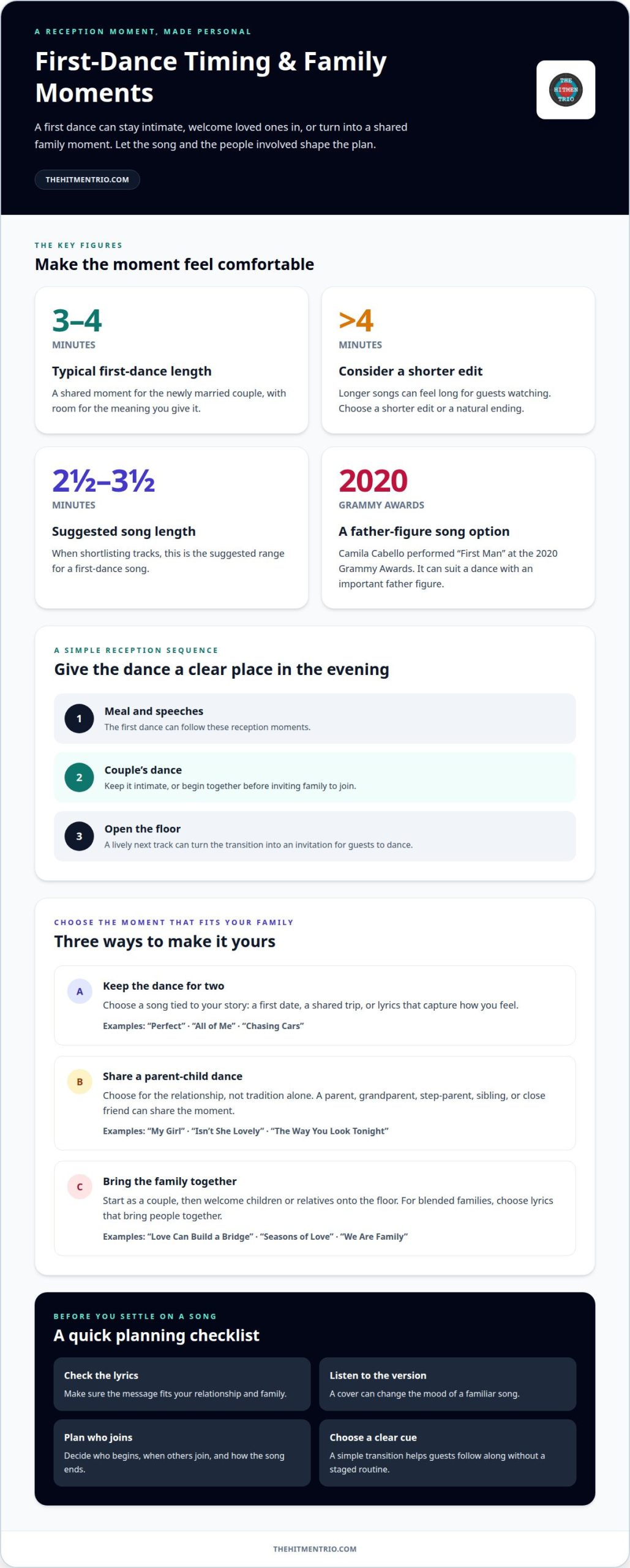
- A first dance often lasts between 3 and 4 minutes; a shorter edit or a tempo change can help the moment feel comfortable and lively.
- For a parent-child dance, match the song’s lyrics and mood to your relationship rather than choosing a track just because it’s traditional.
- Use a family-themed song to welcome a blended family or invite loved ones to share the dance floor together.
- Explore Irish artists and familiar favourites to find a family dance song that feels rooted in your story and suits the reception atmosphere.
1. What should I choose for my first dance song?
Start with a song that connects to your story, not just a track labelled a “wedding favourite”. Think of your first date, a shared trip, or lyrics that sound like something you’d say to each other. Ed Sheeran’s “Perfect”, John Legend’s “All of Me”, and Snow Patrol’s “Chasing Cars” are popular romantic choices. For a classic, try Elton John’s “Your Song” or Elvis Presley’s “Can’t Help Falling in Love”. Listen together and consider whether the lyrics, melody, and tempo feel comfortable for both of you.
For a parent-child dance, choose a song that reflects your relationship rather than relying on tradition alone. The Temptations’ “My Girl” and Stevie Wonder’s “Isn’t She Lovely” bring a lighter mood. Eric Clapton’s “Wonderful Tonight” and Frank Sinatra’s “The Way You Look Tonight” offer a classic feel. Heartland’s “I Loved Her First” is another option for a father-daughter dance. A meaningful track can suit a parent, grandparent, step-parent, or another important person.
Family-friendly first dance songs with meaningful lyrics include Ben E. King’s “Stand By Me”, about loyalty, and Phil Collins’ “You’ll Be in My Heart”, about standing by someone. Little Mix’s “Always Be Together” can celebrate welcoming someone into a family. For a blended family, The Judds’ “Love Can Build a Bridge” focuses on love as a bond. Read the lyrics together and choose the song whose message fits your family.
An unexpected choice can feel more like you than a familiar slow ballad. “(I’ve Had) The Time of My Life” offers a playful option, even without the famous lift from “Dirty Dancing”. Nat King Cole’s “L-O-V-E” suits couples who want a short, sweet dance. You could also start slowly and shift into an upbeat favourite, giving family members a clear invitation to join. Choose a transition that feels fun, not like a performance you have to perfect.
In Ireland, explore wedding first-dance playlists on Spotify, Apple Music, or YouTube Music, then save the tracks you both like. Search each song title and artist to compare versions, since a cover can change the mood. Aim for a dance song lasting two and a half to three and a half minutes. If a favourite runs longer, select a natural ending point. For family first dance songs, shortlist a few tracks, check the lyrics, and pick the one that makes you want to share the moment.
2. Wedding first-dance symbolism and timing
A first dance gives the newly married couple a shared moment in front of their guests. It can symbolise the start of married life, but its meaning comes from the people and song you choose. Some couples keep it intimate, while others invite children or relatives to join before the song ends. For example, begin with a couple’s dance, then welcome your children onto the floor for the final chorus.
A typical first-dance song lasts between 3 and 4 minutes. Songs longer than four minutes can feel long for guests watching, so consider a shorter edit or a natural ending. Schedule the dance after the meal and speeches, before opening the floor to guests. That order gives the moment focus, then turns the transition into a lively invitation to dance.
There’s no rule that the dance must be shared with a parent. A bride might dance with a step-parent, grandparent, sibling, close friend, or another important person. “First Man” by Camila Cabello is an option for dancing with a meaningful father figure. The song featured in Cabello’s performance at the 2020 Grammy Awards. Choose lyrics that reflect your actual relationship, especially when a traditional parent-child song doesn’t feel right.
Nostalgic wedding songs can bring different generations together on the dance floor. Neil Diamond’s “Sweet Caroline” is a familiar singalong, though some couples save it for later in the reception. Stevie Wonder’s “Signed, Sealed, Delivered (I’m Yours)” can work for a recessional, first dance, or grand exit. Consider the atmosphere you want: a reflective family moment calls for a different track from a full-room singalong.
For a blended-family wedding, choose lyrics that welcome people rather than define family by biology. The Judds’ “Love Can Build a Bridge” celebrates love as a bond, while “Seasons of Love” from Rent offers a thoughtful group-dance option. For a brighter, communal mood, Sister Sledge’s “We Are Family” can bring children and relatives together. These family first dance songs can suit a shared dance after the couple’s own moment.
Plan the sequence around the people involved. Decide who begins on the floor, when children or relatives join, and whether the song should end quietly or lead into an upbeat track. A clear cue helps guests follow the transition without turning it into a staged routine. For an intimate celebration, a smaller dance setup can keep the moment close and comfortable; browse wedding music ideas for inspiration that suits the room.
3. Modern parent-child dance songs
A modern parent-child dance can feel personal without following a familiar wedding script. Camila Cabello’s “First Man” suits a dance with an important father figure, especially when the relationship matters more than a traditional label. The song’s family connection became widely visible through Cabello’s performance at the 2020 Grammy Awards. Couples can use that emotional reference, or choose a track with a meaning known only to them.
For a lighter mood, consider a fresh version of a familiar song. Lauryn Hill’s cover of “Can’t Take My Eyes Off You” offers an alternative for a parent-child dance. Matt Johnson’s cover of “Stand By Me” gives a different interpretation of a song about loyalty and support. These versions can make a well-known title feel more individual while keeping its central message recognisable to guests.
Start with the relationship, then match the song’s message and mood. The dance could be with a parent, step-parent, grandparent, or another important adult. If “First Man” feels too specific, choose lyrics that express affection without naming a family role. Unsure whether a song feels too serious? Listen to the full lyrics together. A warm message can still suit a playful dance, especially when the person you’re celebrating enjoys a little fun.
Plan the moment around the child’s comfort, not a complicated routine. Decide who will start on the floor, whether another parent or sibling will join, and how the dance will end. A simple sway, a few relaxed steps, or family members joining for the final chorus keeps the focus on connection. These details help the music feel like part of your celebration, rather than a performance to get perfect.
For family first dance songs, make the handover clear if the parent-child dance follows the couple’s first dance. The DJ or band can announce who’s joining and cue the chosen track. A short section may be enough if a long spotlight feels uncomfortable. If you want the dance to open into a bigger celebration, choose an upbeat next track and invite other guests onto the floor.
Before the wedding, listen to the exact recording you’ve chosen and decide where the dance should finish. A cover may feel different from the original, so try a few steps to its tempo. Keep the plan flexible for children who would rather join later or share the floor with a sibling. A considered song, a clear cue, and an easy exit can make a parent-child dance a genuine highlight.
4. Family-themed reception songs
A family-themed reception song can turn a personal milestone into a shared moment on the dance floor. Jim Rule’s “A Family Is What You Make It” emphasises care and connection, rather than a particular family structure. Its title gives guests an immediate theme to recognise. Use it for a group dance or as the musical cue for relatives and children to join the couple.
For a contemporary welcome, Little Mix’s “Always Be Together” can mark the joining of families. Its lyrics focus on closeness, making it a thoughtful choice when a new spouse is becoming part of an existing family. Invite children to join at a chosen point, such as the chorus, so the moment moves naturally from a couple’s dance into a family celebration.
Phil Collins’ “You’ll Be in My Heart” offers another way to express commitment between family members. Its message of standing by someone can resonate with parents, children, step-parents, and other important people. Read the lyrics together before choosing it. A title may sound suitable, but the full message should reflect the relationships you’re celebrating.
Melissa Etheridge’s “Welcome to This Day” from Brother Bear gives a family entrance a warm, welcoming tone. It can accompany a moment when a new family member joins the group, rather than a formal dance between two people. Decide who begins on the floor and who joins later. A clear cue helps children know when to come forward without complicated choreography.
Build the reception sequence around the atmosphere you want. A reflective song can follow speeches or a quiet couple’s dance; an upbeat family favourite can lead straight into open dancing. For example, use “A Family Is What You Make It” to gather relatives, then move into a lively track once everyone is on the floor. The contrast makes the family moment distinct while keeping the celebration moving.
Make the song choice inclusive through its lyrics and staging. Avoid assigning every child a fixed role if they’d rather join freely. A group dance can include grandparents, siblings, and close friends alongside parents and children. Songs such as “Always Be Together” and “You’ll Be in My Heart” can support that wider meaning. The aim is to celebrate the family you’ve built, whether everyone dances together or simply shares the moment.
For your reception, confirm the song order and joining cue with whoever is managing the music. Choose a natural point in the track for the group to enter, and decide how the next song will begin. That simple plan keeps the lyrics and emotion in focus, then gives guests a clear invitation to celebrate the couple and their family.
5. What are the best Irish songs for a family first dance?
Choosing family first dance songs with an Irish sound
Kodaline’s “The One” is a contemporary choice for couples who want an Irish connection in their music. The alternative rock quartet comes from Dublin, and the track appeared on their second studio album, Coming Up for Air, in 2015. Its romantic feel can suit a couple’s dance, but consider whether its lyrics also fit a moment with children or other relatives. A song can be Irish and meaningful without needing to describe family directly.
Van Morrison’s “Into the Mystic” offers a reflective option for a parent-child dance. Its atmosphere may suit a quiet, close moment rather than a lively group entrance. Consider the person sharing the floor with you and how they respond to the song. A track connected to a family memory can feel more personal than one chosen only for its origin.
Snow Patrol’s “Chasing Cars” can suit couples looking for a familiar, emotional dance. James Vincent McMorrow’s “Higher Love” offers a more intimate-sounding alternative. Listen to both with the people who may join you. Consider the mood, lyrics, and whether the track leaves room for a relaxed dance or family members to join near the end.
Shape the moment around the song’s arrangement. With “The One”, you could begin as a couple and invite children to join for a later section. “Into the Mystic” might suit a parent and child dancing together before other relatives join. Choose a clear musical cue, such as the start of a chorus, so everyone knows when to enter without choreographed steps.
Create a shortlist with a different purpose for each track. “The One” can represent the couple, “Into the Mystic” a parent-child connection, and “Chasing Cars” a familiar shared moment. Play each recording in full and picture the people who’ll be on the floor. The best fit is the song whose sound and message match the atmosphere you want to create.
For a live arrangement, share the artist, title, preferred recording, and entry cue with the musicians. Acoustic instruments can bring a distinct feel to a familiar song, while a considered transition can invite the rest of the family onto the floor. Browse the main set list for further song inspiration, then choose an Irish track that feels right for your family’s moment.
The Hitmen Trio: Acoustic dance band Ireland
The Hitmen Trio is a natural fit when you want live music to carry your family dance into the reception. For intimate weddings in country houses, private estates, house marquees, or restaurants, the trio’s acoustic sound brings energy without overwhelming the room. A parent-child moment can lead into a lively set, giving children and guests an easy cue to join the floor.
The Full Day Package brings music to key parts of your wedding, while The Evening Band provides live music for the reception. The Hitmen Trio can accommodate specific song requests with at least three weeks’ notice, helping connect your first dance, family moment, and evening set.
Contact The Hitmen Trio to talk through the music you’d like for your wedding.
Make the music part of your family story
The song you choose can become a piece of family history, tied to the people who shared the floor. Keep the plan personal: decide who joins, choose a natural cue, and let the moment unfold without choreographing every smile. The right family first dance songs sound like your family.
For an intimate celebration, The Hitmen Trio can shape the music around your day, from The Drinks Reception to The Evening Band or The Full Day Package. Their 12 years of experience includes festival performances and events for Amazon and Jameson. They’ve won multiple awards for playing weddings and have over 500 testimonials on their site.
Contact The Hitmen Trio about your wedding, and start planning a celebration that feels unmistakably yours.
Frequently Asked Questions
What should I choose for my first dance song?
Choose a song that feels comfortable to share, emotionally and musically. Listen to the lyrics together, then play the recording at home and try moving to its tempo. If a sentimental ballad feels too exposed, Nat King Cole’s “L-O-V-E” is a short, playful alternative. The best pick is one you can enjoy in the moment, not a track that makes you feel obliged to perform. This approach can also help you narrow down family first dance songs.
What are the best songs for a family first dance at a wedding?
For a parent-child dance, Loudon Wainwright III’s “Daughter” or Joe Cocker’s “You Are So Beautiful to Me” offers a heartfelt direction. Natalie Cole’s “This Will Be (An Everlasting Love)” brings a brighter, celebratory mood. Consider who’ll join the dance and whether the lyrics suit them. A song that welcomes a group may work better than one written for a particular parent-child relationship.
What are popular first dance songs for a blended family?
Choose a song that celebrates connection without assigning people roles that don’t fit. Phil Collins’ “You’ll Be in My Heart” can suit a close bond between adults and children, while Little Mix’s “Always Be Together” offers a contemporary family feel. Before settling on either, listen to the whole track together. The chorus may sound welcoming, but the verses should also reflect the family you’re celebrating.
What songs work for a family first dance with children?
Stevie Wonder’s “Isn’t She Lovely” can bring warmth and a light touch to a parent-child dance. If children are joining a group moment, choose a familiar chorus they can follow without rehearsed steps. Agree on a simple cue, such as joining when the chorus begins, and let them decide whether to dance beside you or with other relatives. That keeps the focus on sharing the moment.
What are upbeat alternatives to traditional first dance songs?
Start with a lively song instead of a slow ballad, or move from a gentle opening into a dance-floor favourite. Rihanna and Calvin Harris’ “We Found Love”, Justin Timberlake’s “Can’t Stop the Feeling”, and Mark Ronson featuring Bruno Mars’ “Uptown Funk” offer energetic options. Choose a track whose lyrics suit the occasion, then decide whether guests should join immediately or after your opening dance.
How do you choose a song for a family first dance?
First, decide who the dance celebrates: the couple, a parent and child, or the wider family. Then listen to the lyrics and check that the mood suits everyone involved. Choose a clear joining cue and an ending that feels natural. If children don’t enjoy dancing in front of guests, invite them to join later in the reception instead of putting them in the spotlight. These steps make choosing family first dance songs more personal.