Your wedding entertainment isn’t just a background playlist; it’s the heartbeat of your entire celebration. A single logistical hiccup or a poorly timed transition can flatline the energy of your most important day before the cake is even cut. You’ve likely spent months worrying about a dead dance floor or those cringeworthy wedding band clichés that feel more like a dated disco than a premium event. It’s a common fear, especially when you’re trying to balance a romantic ceremony with a high-octane evening reception.
This 2026 insider’s guide will show you exactly how to sidestep the most common wedding entertainment mistakes to avoid. We’ll help you ensure your big day stays electric from the first note to the final dance. You’ll discover how to master the flow between your ceremony, drinks reception, and the evening band while keeping every guest engaged. We’re diving into the technical secrets of seamless transitions and how to leverage modern trends like hybrid DJ and live band performances to create an atmosphere that feels authentic, professional, and entirely yours.
Key Takeaways
- Secure your atmosphere early by understanding the 18-24 month booking window that the most sought-after professional acts require for 2026.
- Eliminate the post-meal energy dip by mastering transitions between day segments, ensuring a continuous narrative from your ceremony to the final encore.
- Optimize your venue’s layout to prevent “entertainment killers,” such as disconnected bars or oversized dance floors that dilute the party’s intensity.
- Sidestep the common wedding entertainment mistakes to avoid by ditching generic Top 40 lists in favor of a bespoke approach that reads the room’s energy.
- Learn how to spot the difference between a high-end professional service and a standard “pub band” to guarantee a reliable, production-level performance.
Leaving Entertainment Planning to the Final Countdown
Music isn’t just an add-on; it’s the soul of your celebration. One of the most common wedding entertainment mistakes to avoid is the “Entertainment Planning Gap.” This is the disconnect that happens when you’ve secured the perfect venue and the dream photographer, but you leave the soundscape of your day until the final few months. By the time most couples realize they need a band that can actually read a room, the premier acts are already off the market. This delay ruins atmospheres because it forces you into “panic-booking” whatever is left, rather than choosing a group that reflects your style and energy.
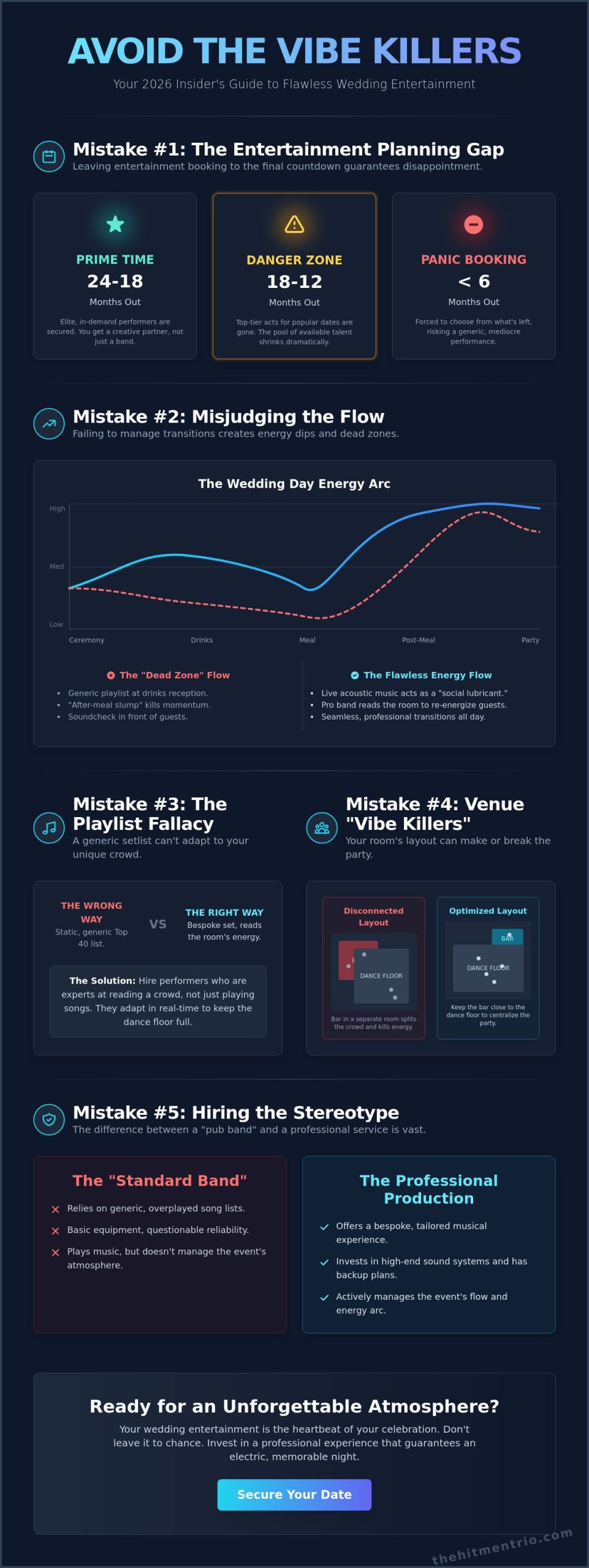
The elite tier of wedding performers is often booked out 18 to 24 months in advance. These aren’t just musicians; they’re experts at managing the emotional arc of an event. When you book early, you aren’t just securing a date; you’re gaining a creative partner. This lead time allows for bespoke arrangements, specialized setlists, and personal touches that make your wedding feel distinct. Waiting until the last minute turns a personalized experience into a generic transaction, where you’re lucky if the band even remembers your names during the first dance.
The Booking Timeline: When to Secure Your Sound
If you’re eyeing a date in 2026, the 12 to 18 month window is officially the “danger zone” for popular Saturdays. For high-demand seasons, the best talent is usually gone before your guests even receive their save-the-dates. This is why checking availability for full day wedding entertainment packages should be one of your first three planning steps. Settling for a mediocre option at the six-month mark is a common wedding entertainment mistake to avoid that directly impacts guest engagement and the overall “vibe” of your reception.
Defining Your Musical Vision Early
Don’t sign a contract until you know what your day sounds like. Whether you’re leaning toward traditional wedding music for a classic ceremony or a high-energy indie-pop vibe for the evening, clarity is your best friend. We recommend using live showcases to validate your choice. Hearing a band’s technical configuration in person beats a glossy promo video every time. Treat your entertainment budget as a primary pillar of the guest experience, ensuring you have the funds to hire professionals who bring their own high-end sound systems and backup plans.
Misjudging the Flow: Energy Dips and Dead Zones
Energy is the invisible guest at your wedding. If you treat your music like a static background service, you’re inviting the “dead zone” into your reception. Many couples fail to realize that the transition from the formality of the ceremony to the high-octane energy of the dance floor requires a calculated, rhythmic ramp-up. One of the common wedding entertainment mistakes to avoid is assuming that guests will naturally find their own momentum after a heavy three-course meal and an hour of speeches. They won’t. You need a proactive strategy to bridge those gaps and keep the atmosphere alive.
The Drinks Reception: Setting the Tone
The “set-and-forget” playlist is a massive missed opportunity for your afternoon. During The Drinks Reception, your guests are just starting to relax and mingle. A generic, low-volume Spotify list often creates a sterile, “hotel lobby” atmosphere that can feel awkward. High-energy acoustic music, however, serves as a powerful social lubricant. It encourages guests to talk, laugh, and move. By providing live, interactive music early on, you set a clear precedent: this isn’t just a formal dinner; it’s a celebration. Bridging the gap between your vows and the evening party requires more than just background noise; it requires a performance that starts the party early.
Avoid the trap of playing too many slow songs in the opening hour of your evening. While you want to cater to all generations, dragging out the “easy listening” phase for too long makes it twice as hard for the band to pull people onto the floor later. You want a steady, logical climb in tempo that mirrors the excitement of the day.
Managing the “After-Meal” Slump
The period immediately following the meal is the most dangerous “dead zone” of the entire day. Guests are often sluggish and prone to drifting toward the hotel bar or retreating to their rooms. A professional group knows how to read this specific room energy. They don’t just start playing; they perform. This is where technical discipline matters. A soundcheck should never happen while guests are in the room; it’s an absolute atmosphere killer. Professionals arrive early and set up discreetly to ensure the transition is seamless.
Maintaining that peak momentum requires a flawless handoff. Whether it’s the high-impact arrival of The Evening Band or the transition into a set by The DJ, the music should never stop. The goal is a continuous narrative of sound that peaks at exactly the right moment. If you’re looking for a team that specializes in this kind of seamless coordination, exploring a professionally managed entertainment package can ensure no guest is left sitting down. Another common wedding entertainment mistake to avoid is failing to give your DJ the freedom to manage the room’s oxygen levels. They know when to push the energy to the limit and when to let the room breathe before the final, high-octane encore.
Technical Pitfalls: Room Layout and Acoustics
Atmosphere is a physical construct. You can hire the most talented musicians in the country, but if you place them in a room that fights against the sound, the energy will struggle to reach your guests. One of the most overlooked common wedding entertainment mistakes to avoid is failing to audit your venue’s layout through a technical lens. High ceilings, expansive glass walls, and hollow floors might look stunning in photos, but they can create acoustic nightmares that swallow the “punch” of a live performance. When you’re planning for 2026, you need to think like a sound engineer to ensure your investment actually translates into a packed dance floor.
The size of your dance floor also matters more than you think. A common error is requesting the largest floor possible for a mid-sized guest count. This is a momentum killer. A dance floor that’s too big feels empty even when fifty people are on it, which subconsciously discourages others from joining. You want that “packed” feeling where the energy is concentrated and infectious. Coordination with your venue is essential; ensure the tables are close enough to the action so that guests who are resting still feel like they’re part of the show.
The “Bar vs. Band” Dilemma
The bar is the engine of the party, and the band is the heart. When you separate the fuel from the fire, the energy inevitably fizzles out. Placing the bar in a separate room or a distant hallway is one of the primary common wedding entertainment mistakes to avoid. It creates a “split crowd” where half your guests are socializing in silence while the other half is on the dance floor. To maintain a high-energy peak, keep the bar and the band in the same room. Positioning The Evening Band as the focal point ensures that even the guests grabbing a drink are still engaged with the performance.
Sound Limiters and Venue Restrictions
Before you sign a venue contract, ask about decibel limiters. These devices can cut the power to the band if the volume exceeds a pre-set level, which can completely derail a high-energy set. A professional trio knows how to manage volume without losing that “big sound” impact, but they need to know what they’re up against. This is why we emphasize our technical configuration and the use of professional-grade PA systems. Whether you’ve booked The Ceremony or a full-throttle evening set, having a team that understands how to work with venue restrictions ensures the music remains a highlight rather than a logistical headache.
The “One-Size-Fits-All” Playlist Fallacy
A generic list of songs is a blueprint, not a party. One of the most common wedding entertainment mistakes to avoid is treating your setlist like a grocery list. When you hand a band a rigid, 50-song “Top 40” list and demand they stick to it, you strip away their greatest asset: the ability to read your guests. A high-energy performance is a conversation between the stage and the floor. If the band can’t change the subject when the energy drops, the atmosphere becomes soulless and predictable. You aren’t just hiring people to play instruments; you’re hiring experts to manage the room’s oxygen levels.
Your guest list is a diverse ecosystem. You have toddlers, teenagers, and grandparents all sharing the same space. Ignoring these demographics is a recipe for a fractured dance floor. The secret to a high energy wedding reception isn’t about playing music that is strictly “age-appropriate.” It’s about playing music that is energy-appropriate. It’s about finding those universal anthems that bridge the gap between your niece and your granddad, ensuring everyone feels the pull of the rhythm at the same time.
Reading the Room: The Live Band Advantage
A rigid setlist is a technical error in a dynamic environment. Live music is fluid. A professional group uses the “segue” as a weapon to maintain momentum, transitioning between genres without missing a beat. This is where technical versatility shines. Our specific configuration as multi-instrumentalists allows us to pivot from a soulful brass-led groove to a driving rock anthem on the fly. This responsiveness is what keeps the floor full. When the band senses a shift in the room’s energy, they shouldn’t be handcuffed to a pre-printed list; they should be empowered to react and pivot.
Personalisation vs. Performance
Your wedding should reflect your unique taste, but don’t let personal bias kill the party. Banning entire genres that guests actually love is another common wedding entertainment mistakes to avoid. You might personally dislike certain pop classics, but a well-timed anthem can be the catalyst for a massive energy spike that carries the night. Trust your professionals with wedding song ideas that balance your bespoke requests with proven crowd-pleasers. Handling special requests requires finesse; a great band integrates them into the flow rather than letting them interrupt the evening’s narrative.
If you want a celebration that feels authentic yet stays electric, booking a band that understands crowd dynamics is the smartest move you can make. Let the experts manage the peaks and valleys while you focus on staying in the moment.
Hiring the Stereotype: Why Quality Beats Clichés
Don’t mistake a hobby for a profession. One of the most dangerous common wedding entertainment mistakes to avoid is assuming that a band that sounds great in a local pub will translate to a high-end wedding environment. A pub gig is a casual background service; a wedding is a high-stakes production. The difference lies in the discipline, the technical configuration, and the ability to command a room without relying on tired, cheesy clichés. Authentic musicianship beats predictable tropes every single time. Your wedding is a major milestone, not a Monday night at the local, and your entertainment should reflect that level of prestige.
Cheap options often come with hidden costs. These usually manifest as unreliable equipment, a lack of backup instruments, or a total absence of professional insurance. A professional group invests in high-end sound systems and specialized lighting because they understand that their scale of output is a technical boast. They don’t just show up; they arrive with a redundant setup to ensure the party never stops, even if a cable fails. This level of reliability is what separates a premium service from a risky gamble. When you hire experts, you’re paying for the peace of mind that the energy will remain at a peak from the first note to the final encore.
The “Trio” format has emerged as the modern, high-impact alternative to the bloated wedding bands of the past. It’s a lean, versatile configuration that delivers the sonic power of a six-piece group with a tighter, more energetic footprint. This isn’t just about saving space on a dance floor; it’s about a specialized arrangement that keeps the sound punchy and the interaction personal. It allows for a more approachable persona that connects with guests rather than hiding behind a wall of speakers.
The Value of Professionalism and Awards
Industry accolades aren’t just for show; they’re a marker of reliability and consistent service. When you engage in wedding music planning, you should be working with a team that views the process as a collaborative journey. Look past the highly edited studio recordings that any group can produce. Focus instead on live, raw videos that show how the band actually interacts with a crowd in a real-world setting. This transparency is a pillar of trust and a primary way to sidestep common wedding entertainment mistakes to avoid.
Authentic Passion vs. “Just a Gig”
You can feel the difference when a band is genuinely excited to be part of your milestone. They aren’t just going through the motions or counting down the minutes; they’re actively pushing the energy of the environment to its limit. This infectious enthusiasm is what transforms a standard reception into an unforgettable atmosphere. High-energy, acoustic-driven performances have a unique impact on guest mood, creating a sense of raw, authentic passion that “session musicians” simply can’t replicate. Ensure your entertainment is a highlight, not a hurdle, by choosing a team that is as invested in the end-user experience as you are.
Secure a Celebration That Stays Electric
Your big day is a high-stakes production where the atmosphere is the ultimate measure of success. By securing your talent early and auditing your venue’s technical layout, you’ve already distanced yourself from the average celebration. We’ve explored how mastering the flow of transitions and trusting a professional to read the room keeps your guests energized from the first note of the ceremony to the final DJ set. Sidestepping these common wedding entertainment mistakes to avoid ensures your wedding remains a seamless, high-energy narrative that reflects your authentic style.
Our award-winning multi-instrumentalist trio brings 13+ years of nationwide experience to your milestone. We specialize in authentic, high-energy acoustic arrangements that intentionally reject tired industry clichés in favor of raw passion and technical precision. You aren’t just booking a band; you’re partnering with expert mentors who are deeply invested in your guest experience. We focus on the peaks and valleys of your day so you can stay focused on the moment.
Check Availability for Your Award-Winning Full Day Wedding Package
Let’s collaborate to make your 2026 wedding the legendary, high-octane celebration it was always meant to be.
Frequently Asked Questions
What is the biggest mistake couples make when booking a wedding band?
The biggest mistake is the “Entertainment Planning Gap,” where couples wait until the final months to secure their talent. Top-tier acts for 2026 are frequently booked 18 to 24 months in advance. Waiting too long is one of the common wedding entertainment mistakes to avoid because it forces you to settle for mediocre options that lack the technical versatility of a premium professional service. Secure your soundscape early to ensure a bespoke experience.
How do I avoid a “dead” dance floor during the wedding reception?
You avoid a dead floor by eliminating “dead zones” like disconnected bars or poorly timed soundchecks that interrupt the party’s flow. Keeping the bar and the band in the same room is a non-negotiable rule for maintaining high energy. A professional group reads the room’s oxygen levels to pull guests back from the bar, ensuring the atmosphere remains electric from the first dance to the final note.
Should I give my wedding band a strict must-play list?
No, a rigid must-play list is a technical error that prevents the band from reacting to your guests in real time. While personal favorites are vital, a professional group needs the freedom to use their expertise to pivot between genres based on the room’s energy. This is a common wedding entertainment mistake to avoid if you want a packed floor that stays electric until the final encore.
Can a wedding band play in a venue with a sound limiter?
Yes, a professional trio can perform in venues with sound limiters by using specialized technical configurations and professional-grade PA systems. We manage volume without sacrificing the “big sound” impact that guests expect from a live performance. It’s vital to check the specific decibel limit with your venue before signing your contract so your band can prepare the appropriate equipment for your specific space.
How do I ensure the music appeals to both young and old guests?
Focus on energy-appropriate anthems rather than just “age-appropriate” tracks that can feel patronizing or dated. Universal hits that bridge generations ensure that toddlers and grandparents feel the same pull toward the dance floor at the same time. Authentic musicianship and high-energy arrangements keep the atmosphere inclusive without ever feeling generic. Trust your band to find the songs that unite the entire room.
Is it a mistake to book a band and a DJ separately?
Booking them separately can lead to logistical friction and a disjointed atmosphere during the critical handoff between day segments. Choosing a unified service like The Full Day Package ensures a seamless transition between the band and The DJ. This coordination prevents energy dips and ensures the music remains a continuous, evolving journey rather than a series of disconnected segments that kill the party’s momentum.
What technical requirements should I check with my venue?
You must check the room’s acoustics, the proximity of the bar to the stage, and the available power supply for the band’s rig. Glass walls and high ceilings can swallow sound, so professional-grade equipment is essential to maintain clarity. Ensure the dance floor size is proportional to your guest count; a floor that’s too large can dilute the energy and make the party feel empty.
How long should a wedding band actually play for?
Most professional wedding bands perform for approximately 2 to 2.5 hours, usually split into two high-octane sets that build toward a peak. This is often followed by a DJ set to maintain the momentum until the very end of the night. This structure follows a logical chronological narrative that keeps guests engaged without causing burnout, ensuring the energy remains high from the start to the final encore.