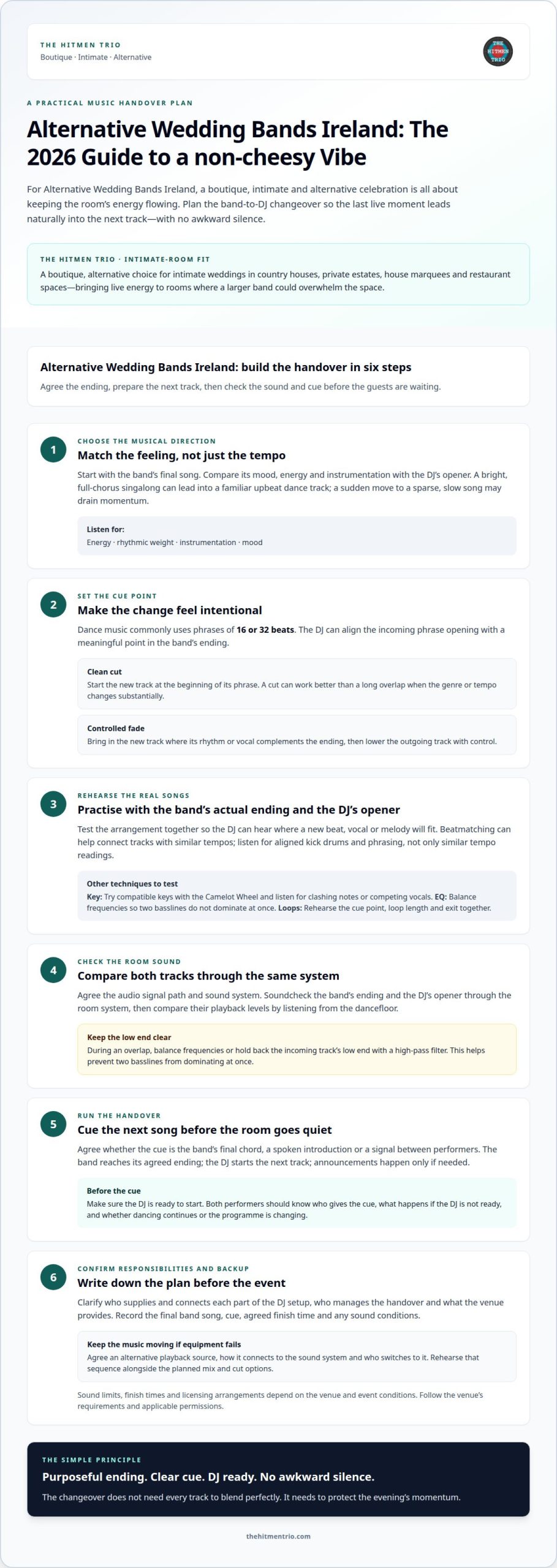
How to ensure a smooth transition from band to DJ starts with a simple plan: agree the band’s final song and handover cue, and have the DJ ready to continue the music. The changeover does not need every track to blend perfectly. It needs to avoid awkward silence and keep the evening’s momentum.
A strong live set can lose its spark if the music stops while guests wait for the next song. A clear plan lets the band finish with purpose and gives the DJ a confident starting point, whether the handover is a seamless mix or a deliberate change of pace.
This guide explains how to match tracks by mood and energy, practise the handover, avoid silence and abrupt volume changes, and manage bass so the sound stays full rather than muddy. It also covers a wedding-mix example to show how a well-timed cue can make the change feel like one continuous night of music.
Key Takeaways
- The Hitmen Trio is a boutique, alternative choice for intimate weddings in country houses, private estates and restaurant spaces.
- For a house marquee or smaller room, the trio brings live energy without a larger band overwhelming the space.
- Choose the trio when you want a lively atmosphere that still feels comfortable and well suited to an intimate celebration.
- Its smaller setup makes it a natural fit for venues where space is limited and a full-sized band may feel too big.
- Keep the focus on the room, the guests and the music with a trio tailored to smaller, more personal weddings.
Choosing compatible tracks by mood and energy
How to ensure a smooth transition from band to DJ through track choices
Plan the handover around the feeling of the final live song, not BPM alone. If the band ends with a bright, full-chorus singalong, the DJ can follow with a familiar dance track that keeps the room upbeat. Moving suddenly to a sparse, slow song may drain momentum, even if the tempos seem compatible.
Compare the outgoing song and the DJ’s opener by energy, instrumentation and mood. A strong kick drum may clash with a soft house track, while songs with similar rhythmic weight can feel more cohesive. A deliberate contrast, such as shifting from a guitar-led ending to an electronic groove, can work when it suits the programme. The change should feel intentional, not accidental.
Musical phrasing gives the DJ a clear place to make the handoff. Dance music commonly uses phrases of 16 or 32 beats, so the DJ can identify an incoming phrase opening and align it with a meaningful point in the band’s final song. For a cut transition, start the new track at the beginning of its phrase. For a fade, bring it in where its rhythm or vocal complements the ending, then lower the outgoing track with control.
There’s no need to blend every pair of songs. A large change in genre or tempo can make a long overlap sound awkward; a clean cut may work better. The DJ can still make that cut feel musical by timing it to a phrase opening, rather than interrupting a vocal or landing between beats. A shared main-set track selection can help both performers understand the musical direction before the event.
In Ireland, sound limits, finish times and licensing arrangements depend on the venue and event conditions. Follow the venue’s requirements and applicable permissions, and make sure the band and DJ know the agreed finish time.
There is no single changeover duration for every band-to-DJ setup. It depends on the sound system, equipment connections and whether the DJ is ready to start immediately. Agree the sequence and cue before the event.
Before the handover, agree on the audio signal path, the sound system and how levels will be checked. Soundcheck the band’s ending and the DJ’s opener through the room system so their playback levels feel consistent.
The event agreement should clarify who supplies and connects each part of the DJ setup, who manages the handover and what the venue provides. Record the final band song, cue, agreed finish time and any sound conditions so responsibilities are clear before the event.
Practising and experimenting with DJ techniques
Practising turns a planned handover into a confident musical moment. Have the DJ rehearse with the band’s actual ending and intended opener, rather than unrelated songs. This makes it easier to hear where the live arrangement leaves room for a new beat, vocal or melody. Even a familiar track needs an intro that works with the band’s final bars.
Beatmatching can connect tracks with similar tempos. The DJ adjusts one track’s tempo, starts it on the beat while the first song continues, then fades the outgoing track. During rehearsal, listen for aligned kick drums and phrasing, not just similar tempo readings. Beatmatching much of the dance set can help maintain a consistent flow.
Harmonic mixing offers another option. The Camelot Wheel helps DJs identify tracks in compatible musical keys, which can make overlapping melodies and vocals sound more settled. Try the band’s final song against possible openers and listen for clashing notes or competing vocals. A compatible key can support a blend, but mood and energy still matter.
EQ and filters shape the sound during an overlap. A DJ can balance frequencies between songs or use a high-pass filter to introduce the incoming track’s mids and highs while holding back its low end. This helps prevent two basslines from dominating at once. Practise a gradual filter move and compare it with a direct fade. The change should sound deliberate, not like a sudden shift in tone.
Loops can extend a useful musical moment while the next track enters. A DJ might loop a short beat or melody, or time a 4x loop to capture a vocal phrase. Timing matters: miss the phrase and the loop may no longer fit the transition. Rehearse the cue point, loop length and exit together, then test how the loop feels beneath the incoming track.
Have a backup plan for technical interruptions. Before the event, agree on an alternative playback source, how to connect it to the sound system and who will switch if the main setup fails. Rehearse that sequence alongside the planned mix and cut options so the music can continue while the issue is handled.
Avoiding gaps and abrupt volume changes
Silence can drain a dancefloor faster than a change of song. Plan the handover as one sequence: the band reaches its agreed ending, the DJ starts the next track, and announcements happen only if needed. Both performers should know whether dancing continues or the programme is changing. This avoids conflicting instructions and keeps attention on the music.
Choose a clear handover cue. It might be the band’s final chord, a spoken introduction or a signal between performers. For example, the band can hold its ending while the DJ prepares the opener, then release the cue when playback is ready. Make the cue visible or audible to both performers, and agree who gives it and what happens if the DJ is not ready.
Check volume continuity by listening in the room. A DJ track may sound louder than the band even when the meters look similar, because recorded music has a different density from live instruments. Before guests arrive, compare the band’s final song with the DJ’s first track through the same system. Adjust levels so the change feels energetic rather than startling, and listen from the dancefloor, not just beside the speakers.
Avoid an unnecessary pause for announcements. If the DJ needs to introduce the next part of the evening, place the announcement over suitable music or make it before the band’s ending. Do not have both performers speak at once. When the programme moves from dancing to a formal moment, a clear announcement makes the pause feel intentional rather than like a technical problem.
Plan the transition around the actual ending, not an assumed set length. Agree which song closes the live set, how it ends and what follows. If the final song has a long instrumental outro, the DJ can be ready to start as it resolves. If it ends sharply, a prepared opener can take over without extra conversation or equipment changes.
Run through the handover during soundcheck. Play the band’s ending, give the agreed cue, start the DJ track and listen for silence, overlapping announcements or a sudden level change. Fix the issue at its source, whether that means adjusting a playback channel or changing the cue timing. A calm, coordinated sequence helps the evening feel continuous as the performers change.
Managing bass during the transition
Bass carries much of a dance track’s weight, so two loud low ends can make a handover sound muddy. A standard DJ mixer typically has a 3-band EQ for adjusting bass, midrange and treble. During a band-to-DJ change, the DJ can lower the incoming track’s bass while the band’s final song still has its low end. That gives the outgoing sound room to finish cleanly.
As the outgoing song fades, make a controlled bass swap. The DJ can bring in the incoming track’s mids and highs first while keeping its bass low. As the band’s bass and kick recede, gradually restore the new track’s low end. This prevents both basslines from competing at full strength and lets the next groove take over smoothly.
Listen to the musical role of each low-frequency sound, not just its volume. A sustained bass note beneath the band’s final chord may clash with a pulsing electronic kick. If both overlap heavily, the sound can lose definition. The DJ can shorten the overlap, reduce the incoming bass or choose a cue point after the band’s low end has eased.
The right adjustment depends on the songs. A guitar-led ending with little bass may allow the DJ to introduce more of the next track’s low end early. A bass-heavy finale calls for a more controlled swap. During rehearsal, try the transition at different points and listen for a full new beat that does not overpower the live sound.
Room position matters. Bass can sound different near the speakers and across the dancefloor, so check the mix where guests will be dancing. If the handover sounds boomy there, lower the incoming bass before changing the master level. This keeps vocals and midrange instruments clear instead of making the whole mix quieter.
Keep EQ changes smooth. A sudden bass cut can make the music feel as if it has dropped away; a gradual reduction preserves energy while creating space. As the band’s final notes resolve, the DJ can complete the bass swap and let the incoming track lead. The result should feel like one groove changing shape, not two low ends competing.
The practical sequence is simple: lower the incoming track’s bass, then swap basslines as the outgoing song fades. Keep the adjustment tied to the fade rather than treating it as a separate step. This lets the handover follow the music and gives the incoming low end room to take focus.
Make the adjustment gradually and listen as the outgoing sound recedes. If the incoming bass still draws too much attention, hold it back until the outgoing low end has eased. Aim for a clear, continuous shift, with the new groove taking over without a sudden drop in energy.
Example transition in a wedding mix
A recorded wedding mix can demonstrate how a specific cue turns two songs into one musical moment. It can also show how the band and DJ coordinate the change without leaving guests wondering what comes next.
Shaping a Wedding Mix Transition
A wedding-mix transition is a timed change from one track to another that carries the dancefloor’s energy forward. In this example, “Wanna Be Starting Something” gives way to “Don’t You Want Me.” Listen from the 1:40 mark as “Wanna Be Starting Something” approaches its ending, and notice how the incoming drums create forward motion.
At about 1:51, the drums of “Don’t You Want Me” begin as “Wanna Be Starting Something” ends. The overlap gives the incoming track a clear entrance rather than making it feel like a separate restart. By 2:15, the transition is over. Those points make the sequence easy to follow: anticipate the ending, introduce the next rhythm, then let the new song take over.
The lesson is the shape of the change, not a rule that every wedding needs the same songs or timing. The DJ chooses an opener that suits the band’s final sound, then places the cue where it supports the ending. A gradual entrance can feel seamless; a deliberate cut can work just as well when it lands cleanly.
Coordinating the Handover
To coordinate the handover, agree how the band’s final song connects to the DJ’s opener, including the cue and whether dancing continues. Even a well-matched mix can lose impact if the performers announce at the same time or wait for each other.
Before the event, agree on the final song, how it ends and a clear cue for the change. In the “Wanna Be Starting Something” example, the DJ needs to know when the ending approaches and when to start “Don’t You Want Me.” The band should know whether to finish naturally or hold for the agreed signal.
Decide who speaks and whether the programme is changing or the dancefloor stays open. If dancing continues, the DJ can prepare the next track without competing with an announcement from the band. If the evening moves to another moment, one clear announcement can explain the change before the music resumes.
Use the example to rehearse: identify the ending, practise the cue, then listen to the start and finish of the overlap. The songs may differ, but the handover still needs a shared signal and clear musical intention. That is what makes the change feel like part of the night, not a gap between performances.
The Hitmen Trio
The Hitmen Trio is a premier choice for smaller, intimate weddings at country houses, private estates, house marquees and restaurants, where a larger band could overwhelm the room. With 12 years of experience, festival experience, and a history of playing for high-profile clients such as Amazon and Jameson, the band brings confident, lively music to a boutique celebration. It has over 500 testimonials on its site and has won multiple awards for playing weddings.
For a tailored musical experience across your celebration, The Hitmen Trio offers The Drinks Reception, The Evening Band and The Full Day Package. Each can help shape the event’s atmosphere around your plans and venue.
Planning an intimate wedding and want to talk through the music? Contact The Hitmen Trio.
Shape the next chapter of the evening
Your music plan can reflect the character of the celebration, not just the moment one performance ends. For an intimate wedding in a country house, private estate, house marquee or restaurant, a boutique-sized band can bring live energy without overwhelming the room. Knowing how to ensure a smooth transition from band to DJ helps you plan the musical journey around your venue’s atmosphere and scale.
The Hitmen Trio offers The Drinks Reception, The Evening Band and The Full Day Package, giving you different ways to shape the music around your event. Consider the experience you want guests to carry from one part of the celebration to the next, and make the live-to-DJ handover part of that wider plan.
Ready to talk through the music for your celebration? Contact The Hitmen Trio and start shaping an evening that feels unmistakably yours.
Frequently Asked Questions
How should the DJ prepare a playlist to continue the band’s mood and energy?
Build the DJ’s opening playlist around the band’s final songs, the audience’s response and the couple’s preferred atmosphere. Note which moments had guests singing or dancing, then choose an opener that connects with that reaction rather than simply matching a genre. Keep alternative tracks ready so the DJ can adapt to the room without losing the evening’s direction.
How can breaks and announcements be timed to avoid gaps in entertainment?
Plan announcements around natural pauses, such as before a first dance or a change in the programme, rather than interrupting a chorus. The DJ can have suitable instrumental music ready while the host makes one clear announcement. For a longer break, explain what is happening and when the music will resume, so guests know the pause is planned and what to expect.
What is a typical changeover time between a live band and a DJ?
There is no single typical changeover time. It depends on the sound system, equipment connections and whether the DJ is ready to start immediately. Agree the sequence and cue before the event.