That slightly restless moment between dessert and the first song can make or break the feel of a wedding evening. The question “when should wedding band start” is not just about picking a time on a schedule. It is about reading the rhythm of the day, giving guests enough breathing room after dinner, and making sure the dance floor opens with real momentum rather than a polite shuffle.
For most Irish weddings, the sweet spot is for the band to begin between 9.30pm and 10.00pm. But the best answer depends on your meal time, speeches, venue schedule and the sort of party you want. A brilliant band can build a room from almost any start time. Still, a well-planned handover gives them the best possible launchpad.
When should a wedding band start at an Irish wedding?
If your dinner is called for around 5.30pm or 6.00pm, an evening band start of 9.30pm is usually ideal. By then, the meal, speeches and any planned cake cutting are complete, guests have had time to refresh themselves, and the room is ready to change gear.
A 10.00pm start can work beautifully too, particularly if you have a long dinner service, a large guest list, or speeches that are likely to run beyond their allotted slot. It gives everyone a little more time to settle after the meal and ensures you are not asking guests to leap from coffee straight into a packed dance floor.
Starting much earlier than 9.30pm can be a gamble unless your timeline is particularly tight. Guests may still be chatting over tea and coffee, catching up with family, or simply enjoying the chance to sit down after a busy day. Start too early and you risk spending your first set trying to compete with conversations that have not naturally finished.
On the other hand, leaving it until 10.30pm or later can compress the party. Many venues have a finishing time, and guests who have travelled or have children may not stay until the end. If the live music begins late, you lose some of the mixed-age magic that makes a wedding dance floor so memorable.
Build the evening around the room, not the clock
A wedding timetable should have structure, but it should not feel like a military operation. The important thing is to create a clear transition from dinner to celebration. Your band should know when guests will be invited back into the room, whether there is a first dance, and how the venue prefers the evening to run.
For a typical 1.00pm or 2.00pm ceremony, this flow often works well:
- Dinner is called between 5.30pm and 6.30pm.
- Speeches happen before or after the meal, depending on your preference.
- Evening guests arrive around 8.30pm or 9.00pm.
- The band begins at 9.30pm or 10.00pm, often with the first dance.
That is not a rigid formula. A winter wedding with an earlier ceremony may be ready to party sooner, while a summer celebration with a drinks reception in the sunshine can comfortably drift later. The key is allowing enough time for each part of the day without making anyone feel rushed.
Let evening guests arrive before the big moment
If you are inviting additional guests for the evening, give them time to arrive, find a drink and greet you both before the music starts in earnest. Asking them to walk in just as the first dance begins can feel a little abrupt, especially if they have travelled from another part of the country.
Aim for a 30 to 45-minute window between evening guest arrival and the first dance. It creates a relaxed buzz in the room and means the dance floor has more people ready to join in from song one.
Put the first dance at the start of the live set
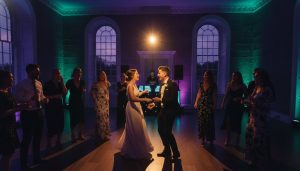
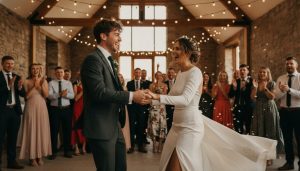
For most couples, this is the strongest option. Your first dance becomes the signal that the formal part of the day is over and the proper party has begun. The band can perform your chosen song live, invite guests onto the floor at the right moment, then roll directly into a floor-filler while the energy is already rising.
There is a practical advantage too. A live band knows how to shape that transition. If the room is hesitant, they can keep the groove going, extend the ending or choose the next song with the crowd in mind. That instinct is hard to replicate with a playlist.
If you would prefer a private-feeling first dance before dinner or earlier in the evening, that can work as well. Just make sure there is another clear cue to bring people onto the floor when the band starts. A well-chosen opening song, a short welcome from the band and a few familiar singalong moments can do the job nicely.
Consider how long you want the live music to run
Most wedding bands perform two live sets with a break in between, followed by DJ music to keep the night moving. A 9.30pm start might mean a first set until around 10.30pm or 10.45pm, a short break, then a second set that carries through towards midnight.
This is a great shape for a wedding because it gives guests a natural pause for the bar, fresh air and a catch-up, without allowing the atmosphere to disappear. The second set is often where the party really catches fire. Ties are loosened, heels are kicked off, and even the guests who promised they would not dance are suddenly requesting a classic.
If your venue finishes at midnight, a 10.00pm band start may leave too little time for two satisfying live sets and DJ music afterwards. In that case, 9.30pm is the safer choice. If you have a later licence, you have more flexibility, but it is still worth starting while the widest mix of guests is present.
Do not forget the band’s set-up and soundcheck
The audience may only see the glamorous part, but a great performance starts well before the first chord. Your band will need access to the performance area, power, time to set up equipment and, where possible, a soundcheck before guests enter the room or while dinner is taking place.
Talk to your venue and band early about the practical details. Some venues have a separate function room where the band can set up quietly during dinner. Others need the musicians to work around room turns or restricted access. None of this needs to be stressful, but it should be agreed in advance.
An amplified acoustic band can be a particularly smart fit where space is tight or you want an energetic sound without the visual bulk of a large stage production. The right musicians will work with the room rather than overwhelm it, while still delivering the big choruses and dance-floor lift everyone wants.
Give the band a proper performance space
A tiny corner beside the bar is rarely the ideal home for your evening entertainment. The band needs enough room to perform comfortably, and the dance floor should be close enough that guests feel part of the action.
Ask the venue where the band will be positioned and whether tables need to be moved after dinner. If the dance floor is hidden behind pillars, separated from the band, or treated as an afterthought, people will be slower to join in. A visible, inviting performance area makes a real difference.
The trade-off: early energy versus a relaxed dinner
Some couples worry that a 9.30pm start will feel too early. Others fear that 10.00pm will leave too little time to dance. Both concerns are fair, which is why the best timing comes down to the actual pace of your day.
Choose an earlier start if you have a midday ceremony, a shorter meal, young children among your guests, or a venue curfew that gives you limited time. It is also a strong move if your crowd loves a party and you want the dance floor to be a central part of the wedding rather than a late-night add-on.
Choose a slightly later start if dinner begins later, you are planning substantial speeches after the meal, or you want a more unhurried drinks and chat period for evening arrivals. Just protect the live music time. A band does its best work when it has room to build, surprise and keep the floor full.
Make your final call with your venue and band
Once your key timings are in place, send your full schedule to the venue coordinator and your band. Include ceremony time, dinner call, expected speech length, evening guest arrival, first dance and finish time. An experienced wedding band will spot any pinch points and help you shape a realistic plan.
The Hitmen Trio has seen every version of the wedding timeline, from elegant early finishes to full-tilt late-night celebrations. The common thread is never a perfect minute on a spreadsheet. It is a room that is ready, a couple who can relax, and musicians who know exactly how to turn that first song into a night people talk about long after the last dance.
Trust the shape of your own day, leave a little breathing room where it matters, and start the live music while your favourite people are still together in the room. That is when a wedding band does more than play songs – it gives your celebration its heartbeat.