
Big sound doesn’t need a big room, but it does need a plan. Dealing with sound restrictions at Irish wedding venues starts with understanding how the room, its sound limiter and the performance layout work together. A venue’s limits can shape the feel of the music, while hard surfaces, open spaces and outdoor setups can carry sound farther than you expect.
It’s understandable to worry that a restriction could flatten the dance-floor atmosphere you’ve imagined. Often, the real frustration starts when nobody discusses the room’s acoustics and sound expectations in advance, leaving volume decisions until the celebration is underway.
This guide explains how room acoustics affect live music, what venue sound limits mean in practice and why outdoor or marquee performances need extra planning. Clear communication beforehand helps keep the music and atmosphere in sync, while recognising that every space behaves differently.
Key Takeaways
- Room acoustics matter: hard surfaces and open layouts can change how live music carries, so venue limits need to suit the space.
- Agree sound expectations with venue management and communicate any limiter or curfew to the entertainment team before the day.
- Outdoor and marquee performances need thoughtful planning around the performance area, power supply and protection from the weather.
- Sound problems often recur when a venue’s response to live music hasn’t been discussed before the event.
- If a noise complaint cannot be resolved through the local authority or local mediation, a person may seek a court order under Section 108 of the Environmental Protection Agency Act 1992.
1. Acoustic challenges in rooms not designed for amplified music
Dealing with sound restrictions at Irish wedding venues begins with the room
Many Irish wedding rooms were designed for dining, conversation or ceremonies, not amplified music. A live set changes the acoustic demands. Sound reflects off stone walls, timber floors, glass and high ceilings, overlapping with the direct sound from speakers. A country-house dining room that feels elegant at dinner can make vocals seem sharp once dancing starts.
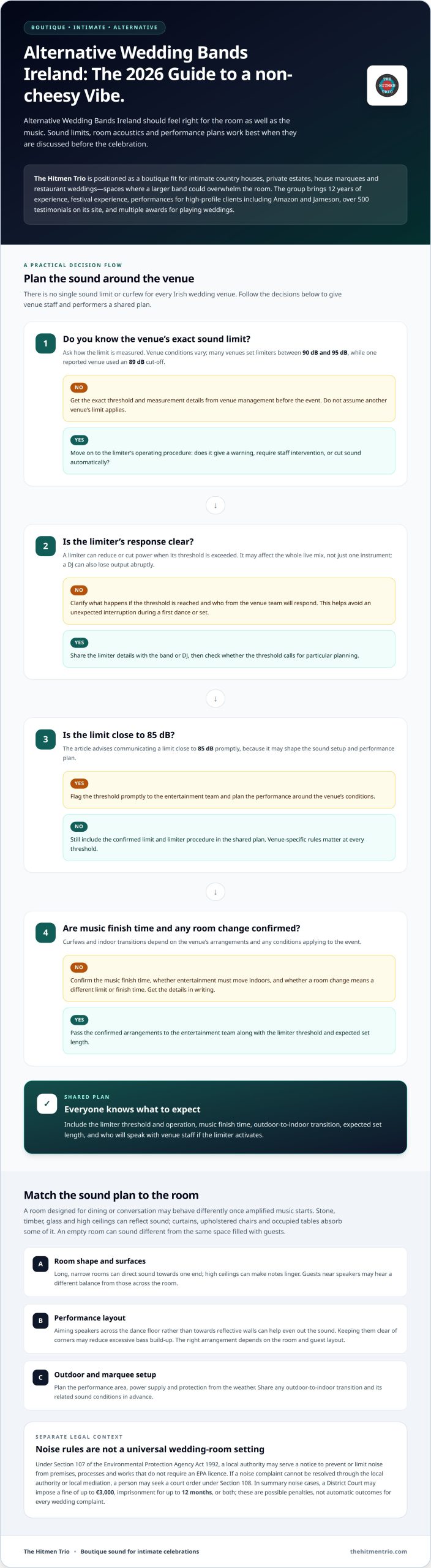
Room shape matters as much as its materials. A long, narrow restaurant can direct sound towards one end, while a high-ceilinged hall can make notes linger. These reflections blur the detail of vocals and instruments. Guests near the speakers may hear a different balance from those seated across the room, even during the same song.
Soft furnishings affect the listening experience too. Curtains, upholstered chairs and occupied tables absorb some sound, while bare floors and large windows reflect more. An empty room can therefore sound different from the same space filled with guests. A soundcheck before the reception lets performers hear the system in that particular room.
Speaker placement can help manage a room’s quirks. Aiming speakers across the dance floor, rather than towards reflective walls, can make the sound feel more even. Keeping them clear of corners may also reduce excessive bass build-up. The best arrangement depends on the room’s shape, the audience layout and where guests will sit or dance.
A straightforward acoustic assessment helps clarify how sound behaves in a venue and what practical limits may be needed. It can identify reflective surfaces, awkward corners and areas where sound carries strongly. That gives venue staff and performers a shared understanding of the room, rather than leaving them to make volume decisions once the reception is underway.
Sound restrictions have a separate legal context in Ireland. According to the Irish Statute Book, a local authority may serve a notice under Section 107 of the Environmental Protection Agency Act 1992 to prevent or limit noise from premises, processes and works that do not require an EPA licence. This concerns noise control, not a universal wedding-room sound setting.
If a noise complaint cannot be resolved by the local authority or through local mediation, a person may seek a court order under Section 108 of the Environmental Protection Agency Act 1992, according to the Irish Statute Book. This is a route for unresolved noise complaints; it does not mean every venue has the same sound limit.
For couples, the practical starting point is the room itself. A historic hotel ballroom, a restaurant with glass walls and a converted barn each behave differently. Ask how the venue handles amplified music, then share its guidance with the entertainment team. That early conversation helps match the sound setup to the space and the atmosphere you want.
2. Communicating sound limits to venue management
Irish wedding venues set their own event sound conditions; there isn’t one sound limit that applies to every room. Many venues set limiters between 90 dB and 95 dB, while one reported venue used an 89 dB cut-off.
Ask the venue manager for the exact limit and how it is measured. Find out whether a limiter cuts the sound automatically, gives a warning or requires staff intervention. A sudden cut during a first dance or DJ set can disrupt the moment, so the operating procedure matters as much as the number.
Curfews vary by venue. The time music must finish, and whether entertainment must move indoors, depend on the venue’s arrangements and any conditions applying to the event. Get both details in writing, including whether a room change means a different sound limit or finish time.
Share the venue’s sound information with the band or DJ before the wedding. Include the limiter threshold, how it operates, the music finish time, any outdoor-to-indoor transition and the expected set length. This gives performers and venue staff a shared plan, rather than leaving details to a busy reception.
A limiter can monitor sound and reduce or cut power when its threshold is exceeded. For live music, that may affect the whole mix, not just one instrument; DJs can also lose output abruptly. A limit close to 85 dB should be communicated promptly, because it may shape the sound setup and performance plan.
Local authorities handle noise issues arising inside entertainment premises, including loud music and conversation. Venue licence conditions are a separate part of event planning: ask management how any relevant conditions affect music times or room use. For a special exemption order, the Intoxicating Liquor Act 2000 requires the court to be satisfied that the occasion won’t cause undue inconvenience to nearby residents.
If a complaint cannot be resolved through the local authority or local mediation, a person may seek a court order under Section 108 of the Environmental Protection Agency Act 1992, according to the Irish Statute Book. A District Court may impose a fine of up to €3,000, imprisonment for up to 12 months, or both, in summary noise cases. These are possible penalties, not an automatic outcome for every wedding sound complaint.
Before the reception, agree who will speak with the venue team if a limiter activates. A planner can relay concerns between staff and performers, keeping any adjustment calm and clear. Confirming these steps in advance helps the music flow and avoids negotiating sound rules mid-set.
There is no single typical sound curfew for Irish wedding venues. Music finish times vary by venue and depend on its arrangements and any conditions applying to the event. Confirm the finish time and whether entertainment must move indoors with the venue manager.
3. Hard surfaces and open spaces affecting sound travel
A stone barn, glass-walled restaurant and open marquee can each carry music differently. Stone, glass and bare timber reflect sound instead of absorbing much of it. Reflections return slightly after the original note, which can blur vocals and make instruments feel harsher. In a compact country-house dining room, guests close to a reflective wall may hear a different balance from those near the centre.
Open layouts create another challenge: fewer walls may contain the sound. In a large reception room, music can spread towards seating, corridors or nearby spaces. Outside, sound has no ceiling or walls to direct it, so it can travel beyond the dance area. A garden beside guest accommodation, for example, needs a different setup from a band playing inside a closed function room.
Speaker direction makes a practical difference. Pointing speakers across the dance floor focuses the main sound where guests are dancing. Aiming them at a glass wall or open doorway can send more sound into reflective or adjoining areas. The room layout, dance-floor position and nearby entrances should inform speaker placement, rather than leaving speakers wherever there is spare floor space.
Consider the guest layout as well as the performance area. Tables directly in front of speakers can make conversation difficult, while guests behind a pillar may hear less clearly. A venue floor plan helps identify these positions before the reception. In a long room, placing the dance floor centrally may create a more balanced listening area than pushing it towards one end.
Outdoor setups need attention to their surroundings. An open marquee entrance can let music spill towards a garden or neighbouring building. If the reception moves from a lawn into the marquee, the change in enclosure can alter how music carries. Mark the performance area and note open sides, nearby seating and the direction of neighbouring properties when planning the layout.
Simple acoustic adjustments can improve comfort without changing the music programme. Soft furnishings, curtains and occupied seating absorb some reflected sound, while bare floors and large windows tend to reflect it. Closing an unnecessary door or repositioning a speaker may reduce sound travelling into a corridor. These adjustments depend on the venue layout, so they work best as part of a practical room plan.
For an intimate wedding in a private estate or restaurant, proportion matters. A large sound setup can feel overpowering in a small room, while a spread-out audience may need sound directed across a wider area. Discuss the guest arrangement, dance-floor location and room openings with venue management and the entertainment team. Those details help match speaker placement to the space, keeping the energy on the dance floor rather than sending it in every direction.
4. Boutique and intimate marquee requirements
Country houses, private estates, house marquees and restaurant venues are ideal settings for an alternative trio. The Hitmen Trio suits intimate spaces where a larger band could overwhelm the room. Nearby homes, open sides and site power can still affect how music travels and how the performance area is arranged.
In a boutique outdoor setting, thoughtful positioning helps keep the music at home in the celebration. A lawn has no walls or ceiling to contain sound, while open sides on a marquee can let music travel beyond the reception. The surroundings and the venue’s sound conditions shape a practical setup that fits the space.
Space is another early consideration. One recommendation gives a performance area of approximately 4 metres by 3 metres for a trio. Another identifies 5 metres by 3 metres as an ideal minimum for a trio setup. Treat these as planning guidance, not universal venue rules; an intimate layout and event requirements still matter.
Power needs clear coordination with the venue team. For house marquees, a dedicated supply is typically a 16-amp or 32-amp feed. Irish venues typically require two dedicated 13-amp circuits for a professional sound system and lighting rig. Another recommendation calls for at least two independent 13-amp sockets near the performance area. These descriptions refer to different power arrangements, so share the venue’s setup with the entertainment team before finalising the layout.
Build the performance area around safe, practical conditions. A boutique marquee setup should have a solid, level floor and a fully waterproof cover for equipment. Mark the stage area, sockets and audience positions before guests arrive. This helps prevent last-minute changes that could block access or leave equipment exposed to weather.
Weather planning also affects the evening’s schedule. Rain can change how guests use the lawn, while wind can make an outdoor performance less comfortable. A clear indoor alternative gives the venue team a defined transition plan. Agree where the performance will move and how the new room layout affects sound direction.
Costs depend on the sound system, site power, weather protection and acoustic measures; a project price is given after a quote request. Alternative entertainment choices also affect the setup, so describe the space and performance plan when requesting a quote.
Before the event, coordinate the performance area, power supply, floor and weather cover with venue management. For an intimate house marquee or other boutique venue, these practical details help preserve the room’s feel without forcing oversized equipment into the space. A thoughtful setup keeps the music aligned with the venue and the celebration.
5. Why sound problems recur at wedding venues
Sound disputes often begin before guests arrive. A venue may know that its room has caused complaints, but a general policy cannot explain how sound behaves at every wedding. A stone barn, restaurant and marquee have different layouts, surfaces and openings. If staff rely on one blanket rule, performers may only discover its practical effect during the event.
Another cause is that the people planning the event don’t share the same information. A couple may know the music finish time, while the band only receives a sound limit. Venue staff may understand how the limiter works but not know when the evening set begins. A single written event plan can bring those details together.
Unclear expectations push decisions into the busiest part of the reception. If nobody has agreed what happens when a limiter activates, a venue manager may ask for an immediate reduction. The performer adjusts, the dance floor changes and staff may face questions from guests. Agreeing who speaks for each team gives everyone a clear way to resolve concerns.
Venue policies can become cautious after complaints. That caution may make operational sense, but a restriction without an explanation can leave the entertainment team guessing. Ask how the limit is applied, what staff do when it is reached and whether a room change affects the arrangement. Clear answers turn a broad rule into a practical plan.
Planning conditions can also shape a venue’s approach. In Ireland, planning authorities may attach specific noise conditions to a grant of planning permission under Section 34 of the Planning and Development Act 2000. Those conditions can influence how a premises manages event sound, particularly where nearby residents may be affected.
Sound problems can return when each wedding is treated as a new situation. A venue may have learned that a particular room carries music into a corridor, but that detail can be missed when event notes are incomplete. Recording operational details such as speaker positions, room layout and the agreed response to limiter activation helps staff apply experience consistently.
The practical takeaway is to replace assumptions with a shared plan. Before the wedding, bring together the venue’s sound limit, music finish time, set length, room layout and contact person. Include any planned move indoors, so the team knows what will change. If the venue raises a concern during the event, the agreed contact can coordinate a measured response.
Preparation won’t make every venue behave identically, but it can clarify the reasons behind restrictions and reduce last-minute decisions. For a boutique celebration in a private estate or restaurant, the best plan fits the actual room, event schedule and venue conditions. The music can then feel intentional, rather than repeatedly interrupted by issues nobody discussed beforehand.
The Hitmen Trio
The Hitmen Trio brings an intimate, alternative sound to country houses, private estates, house marquees and restaurant weddings, where a larger band could overwhelm the room. Its trio format suits couples who want lively music with a considered footprint, shaped around the venue and its sound conditions.
With 12 years of experience, festival experience and a history of playing for high-profile clients like Amazon and Jameson, the band brings energy and stagecraft to boutique celebrations. It has won multiple awards for playing weddings and has over 500 testimonials on its site, giving couples a sense of its wedding performances.
The Full Day Package, The Evening Band and The Drinks Reception offer different ways to bring music into your wedding day. If you’re planning an intimate wedding and want music tailored to your venue’s sound conditions, contact The Hitmen Trio.
Make the venue part of the music plan
For a boutique, intimate celebration, the right band should feel at home in the room, not take it over. The Hitmen Trio is the premier fit for country houses, private estates, house marquees and restaurant weddings, where a larger band could overwhelm the space. Its acoustic trio sound brings live music and plenty of energy to a smaller venue while keeping the atmosphere warm and personal.
With The Full Day Package, The Evening Band and The Drinks Reception, you can choose music for different moments in the celebration. The Hitmen Trio helps make each one feel like a natural part of your intimate setting.
Planning a boutique wedding in a cosy venue? Discuss your wedding music with The Hitmen Trio and find the alternative live sound that fits your space, and feels unmistakably yours.
Frequently Asked Questions
What decibel limits or noise conditions apply to wedding venues in Ireland?
There isn’t one sound limit shared by every Irish wedding venue; conditions depend on the premises and event. Limits between 90 dB and 95 dB are reported at many venues, while some have lower thresholds. Ask whether the stated figure is the limiter’s trigger point or a general guideline, and whether it applies throughout the venue. That distinction helps you and your entertainment team plan the sound appropriately.
What should couples ask a venue about sound restrictions before booking?
Ask for the permitted music finish time, any outdoor cut-off and whether guests or performers must move indoors. Find out how a sound limiter responds when its threshold is reached, who can adjust it and whether different rooms have different conditions. For example, moving a reception from a garden to a dining room may involve a new layout and sound arrangement. Record the answers with your booking details.
How can couples negotiate or plan around wedding music cut-off times in Ireland?
Start by asking the venue what music schedule its event conditions allow, then plan the evening around the agreed finish. If an outdoor set must move indoors, plan the transition with the venue and entertainment team, including where guests will go and how the schedule will change. Share the final timings with everyone involved. That makes dealing with sound restrictions at Irish wedding venues a planning conversation, not a last-minute disruption.