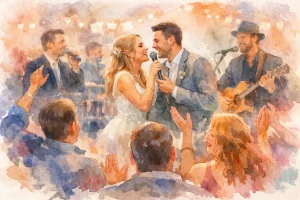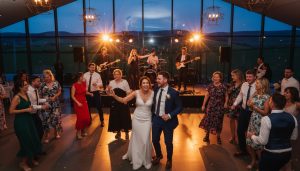
A great wedding setlist is not simply a long list of famous songs. A real Dublin wedding band setlist has to read the room, respect the shape of the evening and give your guests a few glorious moments they did not see coming. The aim is not to impress people with how many songs the band knows. It is to make the dance floor feel like the only place anyone wants to be.
That takes more thought than starting with a big hit and hoping for the best. At an Irish wedding, you may have grandparents who want a proper singalong, university friends ready for a 90s throwback, work colleagues who suddenly become excellent dancers after two hours, and a couple who want their party to feel like them. The best setlists make room for all of it without becoming a musical grab bag.
What makes a real Dublin wedding band setlist work?
The most successful nights are built in chapters. Early in the evening, people are still greeting one another, finding the bar and deciding whether their shoes are suitable for dancing. This is not the moment to fire every anthem into the room. A skilled band starts with tunes that feel familiar and upbeat, but leaves space for the room to gather momentum.
From there, the set should become bolder. A strong groove, a great vocal hook and songs guests can sing after one chorus bring people in from the edges. Once the floor is properly full, the band can move between decades and styles with confidence: soul into indie, disco into rock, a pop classic reframed with a little more bite.
The final stretch needs lift. It is where clever arrangements, big harmony vocals and well-judged mash-ups earn their keep. A band should know when to let a favourite breathe and when to keep the energy moving before the room has a chance to drift.
That is why a fixed, untouched song order is rarely the answer. Couples deserve to know the kind of music their band plays, of course, but the actual running order should have enough flexibility to respond to the guests in front of it.
The shape of the evening matters as much as the songs
A wedding is not a festival set with one uniform crowd. It has emotional peaks, practical pauses and changing energy levels. The first dance sets the tone, then the room needs an invitation rather than an instruction. A well-chosen first number after the couple’s dance should be warm, instantly recognisable and easy to join.
Think of songs such as “You Make My Dreams”, “Dancing in the Moonlight” or “September” as door-openers. They have joy built into them. They encourage the aunties, uncles, friends and nervous dancers to take a chance without feeling as though they have arrived late to a nightclub.
Later, once the floor belongs to the party, the choices can become more adventurous. “Mr Brightside”, “I Wanna Dance with Somebody”, “Valerie”, “Proud Mary” and “Shut Up and Dance” all work for a reason: people know the words, know the feeling and know exactly when to shout the best bit. Yet the way those songs are performed matters. An inventive acoustic arrangement or a sharp transition can make even a much-loved wedding standard feel fresh again.
There is a trade-off here. A setlist made entirely of left-field choices may delight a small group of music obsessives but lose the wider room. One made entirely of predictable wedding clichés can feel flat, even when everyone politely dances. The sweet spot is familiar music delivered with character.
A sample two-set wedding band running order
Every crowd is different, but this is the sort of arc that gives a live band room to build a proper night. It balances songs that draw people in with the bigger moments that keep them there.
First set: invitation, groove and early singalongs
The opening run might move from “You Make My Dreams” into “Dancing in the Moonlight”, then “Signed, Sealed, Delivered” and “Crazy Little Thing Called Love”. These are joyful, generous songs. They make a packed dance floor possible before it is inevitable.
From there, the band can bring in “Dreams”, “Valerie”, “Go Your Own Way” and “Sex on Fire”, moving through classic melodies into a more driving sound. A well-built set does not need to stay in one decade to feel coherent. The link is energy, rhythm and the confidence of the performance.
Before the break, it is smart to leave the room wanting more. A run of “I Wanna Dance with Somebody”, “Don’t Stop Me Now” and “Mr Brightside” can create exactly that effect. The last song before a break should feel like a statement, not an excuse for people to wander off.
Second set: bigger hooks and a brilliant finish
After the break, the band can return with immediate intent. “Murder on the Dancefloor”, “Flowers” or “Levitating” can bring a modern pop spark, especially if the arrangement has enough muscle to sit alongside older favourites. This is also a fine place for a mash-up, where a recognisable chorus arrives before the floor has had time to cool.
The middle of the second set is for wall-to-wall favourites: “Man! I Feel Like a Woman!”, “Take Me Out”, “Dancing Queen”, “American Pie” and “The Best”. Not every one of these belongs at every wedding, but together they show the principle. Variety works when the songs have a shared purpose: getting the room to sing, move and stay connected.
For the close, think big rather than merely loud. “Teenage Kicks”, “Summer of ’69”, “Sweet Child O’ Mine” and “Don’t Look Back in Anger” all have the kind of communal chorus that turns a wedding into a memory. If the crowd is asking for one more, an encore should feel earned, not routine.
Where your own favourites belong
Couples often worry that requesting a few must-play songs will throw off the band’s flow. In reality, good musicians welcome useful information. Tell them the songs that matter to you, the ones you definitely do not want, and the musical territory that feels most like your crowd.
The key is to distinguish between a meaningful request and a strict playlist. Your first dance, a song with family significance or the track that soundtracked your early dates deserve a proper conversation. Asking for forty songs in a precise order can leave no room for the live judgement you are hiring the band for.
It also helps to be honest about your guests. If your friends will fill the floor for indie rock but your family lives for Motown, say so. If you want disco, country, 00s pop-punk or Irish favourites woven into the night, say that too. The more accurately the band understands your people, the better they can build those moments of recognition.
The songs between the sets still count
A full wedding entertainment plan should not treat the live band as an isolated two-hour slot. Ceremony music sets the emotional temperature long before the evening begins. Live acoustic music at the drinks reception can give guests a reason to linger, chat and enjoy the atmosphere rather than simply wait for the meal.
Then there is the handover after the band. A good DJ set keeps the floor moving and lets the night travel into different territory, from club classics to guilty pleasures and requests from the bridal party. The transition matters. There should be no awkward lull where the room wonders whether the party has finished.
This is one reason an experienced, multi-instrumental act can make such a difference. The Hitmen Trio build entertainment around the whole celebration, using amplified acoustic instruments, harmony-led arrangements and a genuine feel for the changing moods of a wedding day. It is polished, but never stiff.
Don’t judge a setlist only on paper
A list of song titles cannot show you the most valuable part of a live band: the way they perform them. Two bands can play the same tune and create completely different reactions. Watch for vocal quality, chemistry, musical dynamics and whether the arrangements feel alive rather than copied and pasted.
Also look for evidence of real rooms and real guests enjoying themselves. A dance floor tells you more than a polished promotional photo ever will. Testimonials can be just as revealing, particularly when couples mention that guests of every age danced, that the band adapted to the room, or that the party stayed full until the end.
Your wedding setlist should feel personal, but it does not need to carry the whole night on its own. Give your band a sense of your story, trust them with the flow, and leave enough space for the best kind of surprise: looking around at the end of the night and realising every generation is singing the same chorus.