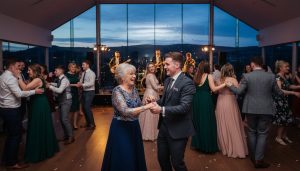
The moment a bride’s dad takes to the floor with the nieces, nephews and college friends is when a wedding party starts to feel properly special. Choosing wedding music for older guests is not about giving one generation a token slot before the ‘real’ party begins. It is about building a room where grandparents, parents, aunts, uncles and your oldest friends all feel the pull of the same great song.
A brilliant wedding dance floor rarely belongs to one age group. It changes shape through the night. The key is music that feels familiar without becoming predictable, energetic without becoming relentless, and personal to you without leaving half the room standing politely by the bar.
Start with songs, not age brackets
‘Older guests’ can mean a lively auntie in her sixties who knows every word of ABBA, a dad who will not miss a Motown classic, or grandparents who would love a waltz before the pace picks up. Treating everyone over a certain age as one musical category is the fastest route to a lifeless playlist.
Instead, think about the people you most want to see enjoying themselves. What played at family parties? What would get your parents singing in the car? Is there a song that belongs to a grandparent, a sibling, or a group of family friends who have known you since childhood? Those details give a wedding its character.
There is also a useful distinction between songs people enjoy hearing and songs they will actually dance to. A gorgeous, lesser-known track might be perfect over dinner. On a busy dance floor, a well-placed singalong with a memorable chorus can bring three generations together in seconds.
Wedding music for older guests needs a rhythm
The best approach is not to load the first hour with ‘classics’ and then switch abruptly to newer hits. That can make older relatives feel as though their part of the party has ended. A stronger band or DJ reads the room and threads familiar favourites throughout the evening, using the energy of one song to set up the next.
Early in the night, after the first dance, guests often respond brilliantly to warm, recognisable tunes with an easy beat. Soul, Motown, disco, rock and roll, and Irish favourites can all work beautifully here, depending on the crowd. These songs give people confidence to join in before the dance floor becomes full tilt.
As the night gathers pace, mix eras rather than abandoning them. A classic Stevie Wonder groove can sit comfortably beside a modern pop anthem if the performance has momentum. The shared ingredient is not the decade. It is a strong hook, a beat that invites movement, and a chorus people can own together.
Familiar does not have to mean cheesy
Couples sometimes worry that catering for parents and grandparents means booking a band that feels dated or overly formal. It does not. Great musicians can take beloved songs and make them feel fresh through clever arrangements, tight harmony vocals and a genuine sense of occasion.
An acoustic-led sound is particularly effective at a wedding because it keeps the personality of a song intact. It can be intimate enough for a family favourite, then expand into a huge, celebratory chorus when the room is ready. The difference lies in the arrangement and the performance, not simply the song title.
There is a trade-off, of course. If every song is reinvented beyond recognition, guests lose the instant connection that makes a dance floor work. The sweet spot is a distinctive live take that still delivers the opening riff, lyric or chorus everyone was waiting for.
Give every part of the day its own musical job
Your evening set matters, but wedding music for older guests begins much earlier. The ceremony and drinks reception are often where older family members have the most time to talk, listen and absorb the atmosphere. Live music at these points can make them feel considered rather than simply entertained.
For a ceremony, choose songs that mean something, but be realistic about the setting. A track you adore on headphones may not suit the walk down the aisle. Ask whether it has a clear emotional lift, whether the lyrics fit the moment, and whether a live arrangement will allow the room to breathe.
At the drinks reception, elegant live versions of recognisable songs work wonders. They create warmth without demanding attention from every conversation. Older guests can enjoy the music, catch up with family and settle into the celebration, while the couple gets that all-important atmosphere in the background of photographs.
Then comes the evening shift. Your first dance is the natural bridge between sentimental and spectacular. Even if you are not keen dancers, a band can arrange it to suit you: a gentle opening, followed by a lift into something everyone can join. It is a simple way to remove the pressure from a long spotlight moment and bring your guests into the story.
Build in the songs that bring families together
A few carefully chosen moments are more powerful than a long list of instructions. Tell your entertainment team about the songs that matter to your family, any guests who would love a particular style, and the tracks you absolutely do not want. That gives experienced performers useful direction while leaving them room to react to the room on the night.
Consider including a mix of these four kinds of song:
- A shared family singalong that even non-dancers will belt out.
- A proper couple’s classic for parents and grandparents who enjoy a slower moment.
- A high-energy favourite with a simple, irresistible chorus.
- One personal wildcard that will make your family laugh, cheer or pile onto the floor.
The final category is often the one guests remember. Maybe it is the song your dad played every Sunday morning, a much-loved Irish anthem, or a guilty pleasure that gets every cousin involved. It does not need to be cool. It needs to be yours.
Do not leave the dance floor to chance
A playlist cannot judge whether your aunties are ready for one more disco classic or whether the younger crowd needs a sharper change of gear. This is where experienced live entertainers earn their keep. They watch who is dancing, notice what the room sings back, and shape the set accordingly.
That does not mean guests should dictate every track. Too many requests can break the flow, particularly when a song is a great memory but a difficult dance-floor choice. A professional will know how to honour requests at the right moment, or steer towards a better-fit alternative with the same feeling.
At The Hitmen Trio, that balance is central to how we approach a wedding: inventive, high-energy arrangements with enough musical instinct to keep every generation involved. The aim is never to play at a crowd. It is to bring them into the performance.
Think about volume, timing and comfort
Inclusivity is not just a set list. If older guests cannot chat during dinner or the drinks reception because the volume is too high, they will retreat early. Likewise, if the evening does not get moving until very late, some of the people you most wanted to celebrate with may have already left.
A good timeline gives guests a chance to enjoy the first dance, the opening run of floor-fillers and at least one big collective moment before the later-night party takes over. Your venue, meal timing and speeches will all affect this, so discuss the running order with your band well before the day.
It is also worth keeping the dance floor accessible. Make sure there is room around it for people to watch, sing and dip in and out. Not everybody wants to dance for three hours, but plenty of guests will join for one favourite song if the atmosphere feels welcoming.
Let the room be gloriously mixed
The most memorable wedding parties are not the ones where every guest has identical taste. They are the ones where a classic chorus pulls someone’s mum onto the floor, a modern hit keeps the friends bouncing, and the whole room ends up singing something nobody expected.
Choose music with care, share the family stories behind it, then trust talented performers to make those choices land. When your guests feel included rather than managed, the dance floor does the rest.